
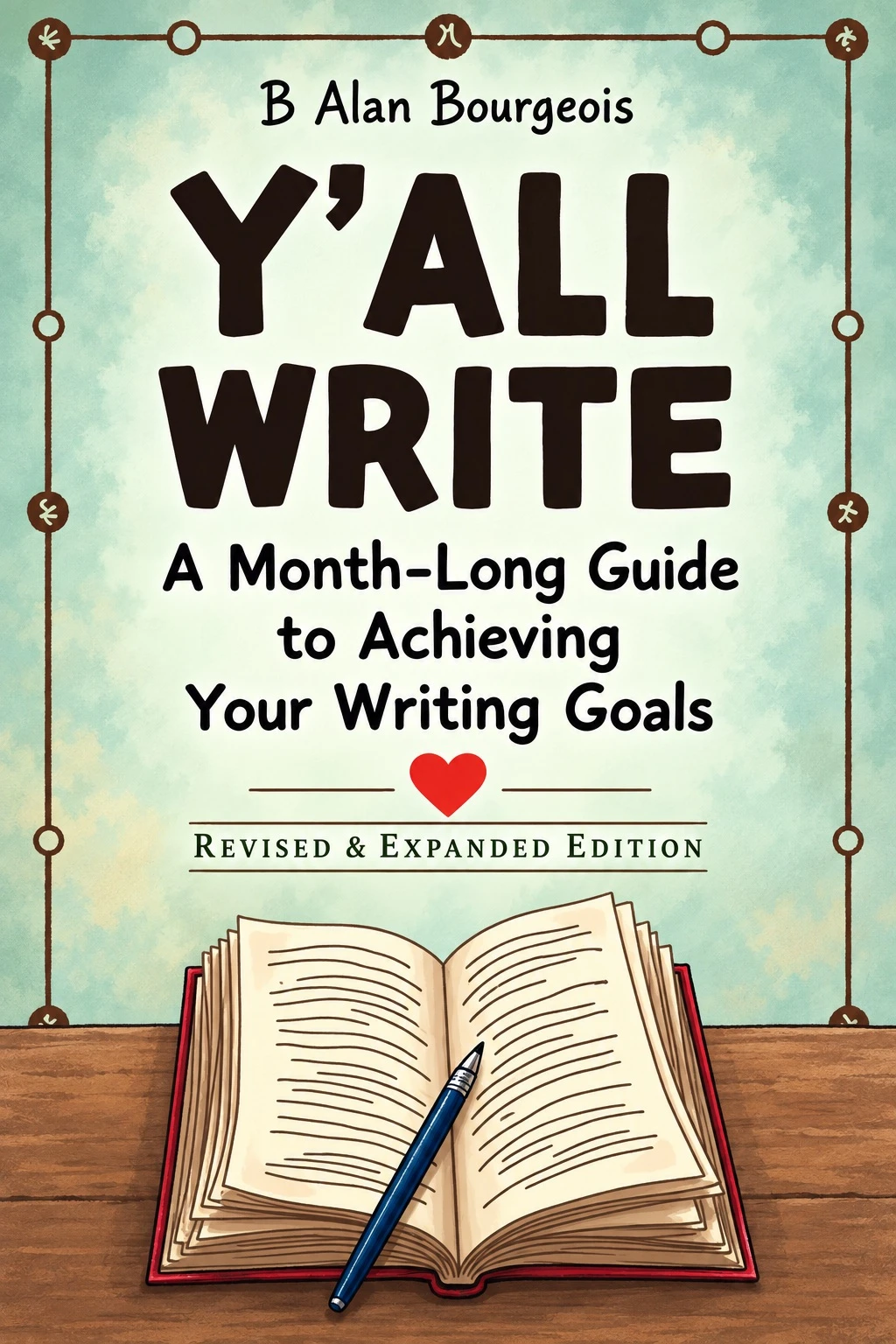
Y’all Write
Ready to Read It?
Use the button or the permanent True Voice Review purchase link.
TrueVoiceReview.com/b/yallwrite Scan to Buy the Book
Quick Take
Y’all Write is an encouraging, flexible month-long writing guide that turns vague creative intentions into manageable goals, daily action, accountability, and a practical plan for continuing afterward.
Short Review
Y’all Write: A Month-Long Guide to Achieving Your Writing Goals is a practical writing-challenge companion focused less on chasing an arbitrary word count and more on helping writers build realistic, sustainable progress.
B Alan Bourgeois organizes the book around preparation, four weeks of active writing, post-challenge reflection, community, prompts, resources, and a substantial workbook section. Writers are encouraged to define success in ways that fit their project, whether that means drafting, revising, researching, completing scenes, or simply writing more consistently. The emphasis throughout is on manageable goals, accountability, resilience, and returning to the work even when enthusiasm fades.
The book’s approachable tone makes it especially suitable for beginning and intermediate writers. Short chapters, exercises, examples, prompts, and weekly check-ins create the feel of a guided workshop rather than a dense craft manual. The expanded workbook and 31 daily micro-challenges are particularly useful, and the final 30/60/90-day plan helps extend the challenge beyond a single month.
Experienced writers may find some advice familiar and occasionally repetitive, particularly around motivation, progress tracking, accountability, and perfectionism. Readers seeking advanced instruction in narrative craft will need a different book.
As a motivational and organizational guide, however, Y’all Write is an inviting, flexible tool for writers who want structure without turning creativity into a punishment.
Full Review
Y’all Write: A Month-Long Guide to Achieving Your Writing Goals is a practical, encouraging guide built around a deceptively simple idea: writers improve by writing, but they are more likely to keep writing when their goals are realistic, measurable, and connected to their actual lives. Rather than centering the month around a single mandatory word-count target, B Alan Bourgeois presents a more flexible challenge that can accommodate novels, short stories, poetry, scripts, memoir, revision, research, or simply the development of a consistent writing habit. That flexibility is one of the book’s clearest strengths.
The book is structured as both guide and workbook. Its early chapters focus on preparation: choosing a meaningful goal, defining success, setting intentions, developing a productive mindset, assembling a writing toolbox, building accountability, and shaping a workable writing environment. The middle section follows the challenge week by week, anticipating the natural shift from early enthusiasm to fatigue, frustration, and the final push toward completion. Later sections address reflection, sustainable habits, writing community, prompts, resources, and a substantial workbook component with daily micro-challenges and a 30/60/90-day follow-through plan.
Bourgeois’s strongest instinct is his resistance to one-size-fits-all definitions of success. Y’all Write repeatedly argues that the biggest goal is not necessarily the best goal; the better goal is the one that creates meaningful progress. The book recognizes that some writers may produce thousands of words a day while others may be revising, outlining, researching, or simply carving out twenty minutes in a crowded schedule. Its central message is consistent: the purpose of the month is not to perform productivity but to build evidence that a writer can keep returning to the work.
The tone is warm, plainspoken, and motivational without becoming aggressively inspirational. Chapters rely on short explanations, lists, examples, reflection exercises, and brief fictionalized case studies. That structure makes the book easy to dip into rather than requiring a straight-through reading experience. Readers who prefer deeply researched writing theory, sophisticated craft analysis, or literary discussion will find this intentionally basic. This is not a book about narrative architecture, voice, point of view, scene construction, or sentence-level technique. It is about process, consistency, accountability, and momentum.
That narrower focus works especially well in chapters dealing with mindset and persistence. Perfectionism, self-doubt, fatigue, distractions, and mid-project loss of confidence are treated as normal parts of the writing process rather than evidence that a writer has failed. The book encourages practical responses: timed sprints, smaller goals, changes in routine, accountability partners, visual progress tracking, and deliberately imperfect drafting.
The community element also distinguishes the book from solitary writing manuals. Bourgeois repeatedly emphasizes accountability partners, writing groups, local organizations, online communities, and mutual encouragement. The underlying philosophy is that writing may happen alone, but writers do not have to struggle alone. The book is at its best when it frames community not as networking for career advantage but as a source of persistence, perspective, and emotional support.
The revised and expanded edition becomes more useful in its final third. The 30 general writing prompts offer character, setting, conflict, speculative, and emotional starting points, while the later 31-day micro-challenge section gives participants something much more directly tied to the month itself. These daily tasks include writing without deleting, ending a session with a note for tomorrow, identifying unanswered questions, switching perspective, writing before checking email or social media, choosing progress over polish, and deciding what must be finished versus what can wait.
The strongest addition may be the closing 90-day plan. Instead of treating the end of the month as the end of the experience, the book asks readers to identify their next milestone, next action, needed support, and 30-, 60-, and 90-day goals. That gives the challenge an afterlife and supports the book’s larger point: one productive month matters most when it changes what happens afterward.
The principal limitation is repetition. Concepts such as showing up, tracking progress, celebrating small wins, using accountability, and choosing progress over perfection recur throughout. For beginners, that reinforcement may be useful. More experienced writers may feel that several sections cover familiar territory and could move faster. The case-study examples are also illustrative rather than deeply developed, giving the book the feel of a guided workshop more than an analytical writing text.
For its intended reader, however, Y’all Write succeeds. It is approachable, practical, flexible, and notably free of the punitive productivity mindset that can make writing challenges feel like endurance tests. Writers looking for a month-long reset, accountability structure, or accessible companion to an organized writing challenge will find a useful framework here, particularly those who need help transforming intention into a repeatable practice.
Pull Quotes
Content Notes
Language: Mild; no notable profanity or slurs.
Violence: None.
Sexual Content: None.
Drugs/Alcohol: None of significance.
Sensitive Topics: Mild discussion of self-doubt, creative burnout, discouragement, perfectionism, frustration, and emotional pressure associated with writing.