
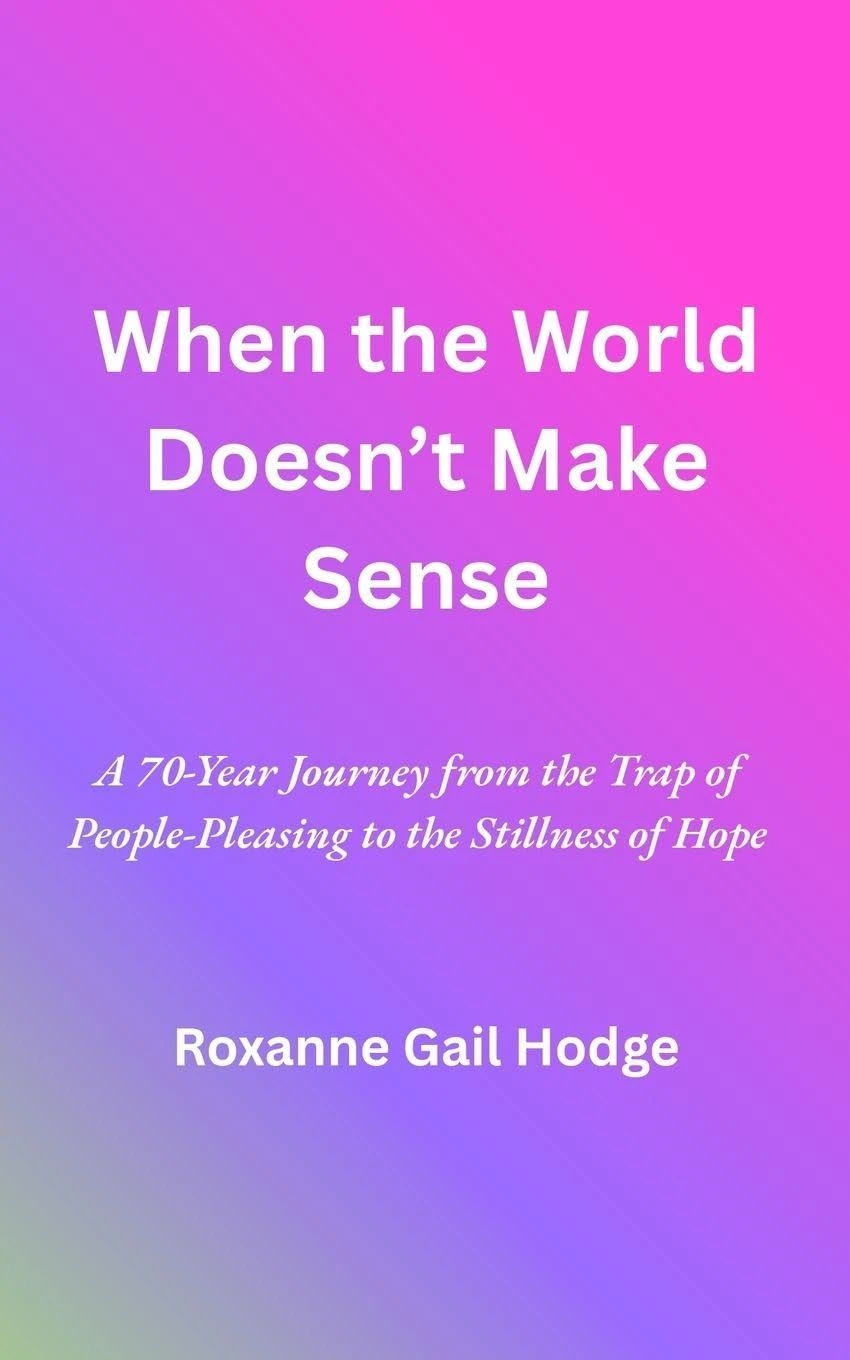
When the World Doesn’t Make Sense
Ready to Read It?
Use the button or the permanent True Voice Review purchase link.
TrueVoiceReview.com/b/whenworld Scan to Buy the Book
Quick Take
Its most compelling insight is that receiving love need not depend on achieving emotional stability, constant productivity, or flawless belief. For Christians exhausted by performance-based expectations, however, Hodge offers a compassionate testimony about learning to receive love without continually proving worthiness.
Short Review
In When the World Doesn’t Make Sense, Roxanne Gail Hodge explores the long reach of people-pleasing: how childhood efforts to stay safe can become an adult conviction that even God’s love must be earned. Drawing on selected experiences across seventy years, she traces the emotional cost of relentless self-monitoring and the search for a faith less governed by fear.
This brief Christian memoir-devotional unfolds in six chapters combining Scripture, personal reflection, and poetry. Hodge is both the central figure and the interpreting voice, examining shame, chronic depression, loneliness, and spiritual restlessness. The tone is intimate, earnest, and ultimately hopeful, with recurring images of bedcovers, changing seasons, and light breaking through darkness.
Its strongest feature is its resistance to an instant-recovery narrative. Hodge acknowledges therapists, family support, and the distance between receiving spiritual reassurance and feeling better. Her descriptions of ordinary frustrations becoming evidence of personal failure give the broader message a recognizable emotional foundation.
The poetry is less consistent. Familiar imagery, uneven rhythms, and rhyme-driven phrasing sometimes weaken its impact, while repeated themes slow an already compact work. The subtitle’s broad span also yields selected reflections rather than a developed life history.
Readers seeking polished literary memoir or detailed mental-health guidance may find the treatment limited. For Christians exhausted by performance-based expectations, however, Hodge offers a compassionate testimony about learning to receive love without continually proving worthiness.
Full Review
The fear of never being good enough can survive long after the people who first inspired it have left the room. In When the World Doesn’t Make Sense: A 70-Year Journey from the Trap of People-Pleasing to the Stillness of Hope, Roxanne Gail Hodge examines how that fear shaped her relationships, her self-understanding, and her Christian faith. This compact blend of personal reflection, devotional prose, and poetry follows a woman learning to separate divine love from the exhausting work of earning approval.
Hodge begins with the habits of a child who learned to monitor expectations and anticipate consequences. An early incident involving a childhood game, an accusation of dishonesty, and an injury requiring an emergency-room visit establishes the stakes behind her desire to please. Being agreeable becomes a means of protection. Religious practice subsequently absorbs the same anxiety: confession, obedience, and constant self-examination become ways of trying to secure a love she fears losing.
The book’s central struggle is therefore both emotional and spiritual. Hodge wants relief from the relentless scrutiny of her own mind, but the beliefs she turns to for reassurance sometimes become another source of judgment. Her account is especially attentive to the experience of carrying childhood patterns into adult faith. The outward circumstances change; the inward question—whether a mistake has made her unacceptable—remains painfully familiar.
Rather than presenting a continuous autobiography, Hodge arranges selected memories and reflections across six short chapters. Scripture introduces each chapter, while poems extend or revisit its emotional concerns. The movement is thematic, circling through shame, depression, loneliness, restlessness, and surrender. Readers looking for a detailed chronology of seventy years will find a much smaller, more concentrated work than the subtitle might suggest. The emphasis falls on interpreting experience rather than documenting a life.
The strongest passages give spiritual anxiety an ordinary setting. Bedcovers become a recurring refuge from self-accusation and emotional exhaustion. Small frustrations take on disproportionate significance when every difficulty seems to indicate personal failure. Hodge understands how an apparently minor event can activate a much older fear. These details make the book’s central concern recognizable without requiring readers to have shared every circumstance of her life.
Her treatment of depression adds seriousness to the devotional material. Hodge describes prolonged suffering and acknowledges the involvement of therapists, family members, and supportive friends. Particularly valuable is her refusal to make one reassuring spiritual experience stand in for immediate recovery. The book allows comfort to matter before circumstances improve. That distinction gives its message more credibility than a simple account of despair instantly yielding to faith.
Christian conviction shapes every part of the work. Hodge understands divine guidance as personal and sometimes describes inward responses she attributes to God. Scripture, Christ’s sacrifice, grace, and the Holy Spirit supply the vocabulary through which she makes sense of suffering. Readers hurt by religious expectations may respond to her challenge to performance-based belief, especially because it comes from someone remaining firmly within Christianity. Readers seeking secular reflection or a broader examination of religious traditions will find its scope limited.
The poems create a more uneven reading experience. Their direct language and familiar images of weather, darkness, light, and shelter make them accessible as devotional expressions. At times, however, rhyme appears to steer the wording, and irregular rhythms interrupt the emotional flow. Because the verse frequently restates insights already expressed in prose, the alternating structure can feel repetitive. Readers drawn to intimate prayer journals may welcome that recurrence; those seeking more varied imagery or sustained narrative development may find it restrictive.
The prose is generally approachable, though occasional awkward constructions reduce its polish. Some broader statements, particularly about online connection, extend beyond what the personal examples establish. The manuscript is most persuasive when describing Hodge’s own experience rather than making claims about how others connect or where they find hope.
There is also an unresolved tension between the book’s patient account of a long struggle and occasional language presenting depression as something spiritually defeated. The acknowledgment of therapy and gradual change provides important context, but readers seeking a detailed mental-health narrative will encounter testimony rather than a comprehensive account of treatment.
For its intended audience, the booklet offers a sincere and often affecting exploration of faith under the pressure of shame. Its most compelling insight is that receiving love need not depend on achieving emotional stability, constant productivity, or flawless belief. Despite uneven verse and a narrow range of recurring images, When the World Doesn’t Make Sense offers Christian readers a compassionate account of learning to live with less self-condemnation and greater room for grace.
Pull Quotes
Content Notes
Language: Mild; a reference to cursing without the words reproduced. No notable slurs.
Violence: Brief, non-graphic childhood physical harm resulting in an emergency-room visit; references to Christ’s crucifixion.
Sexual Content: None.
Drugs/Alcohol: None depicted.
Sensitive Topics: Chronic major depression, two suicide attempts described without methods, psychiatric hospitalization, childhood trauma, a young sibling’s death, dissociation, shame, emotional isolation, and distress associated with religious expectations.