
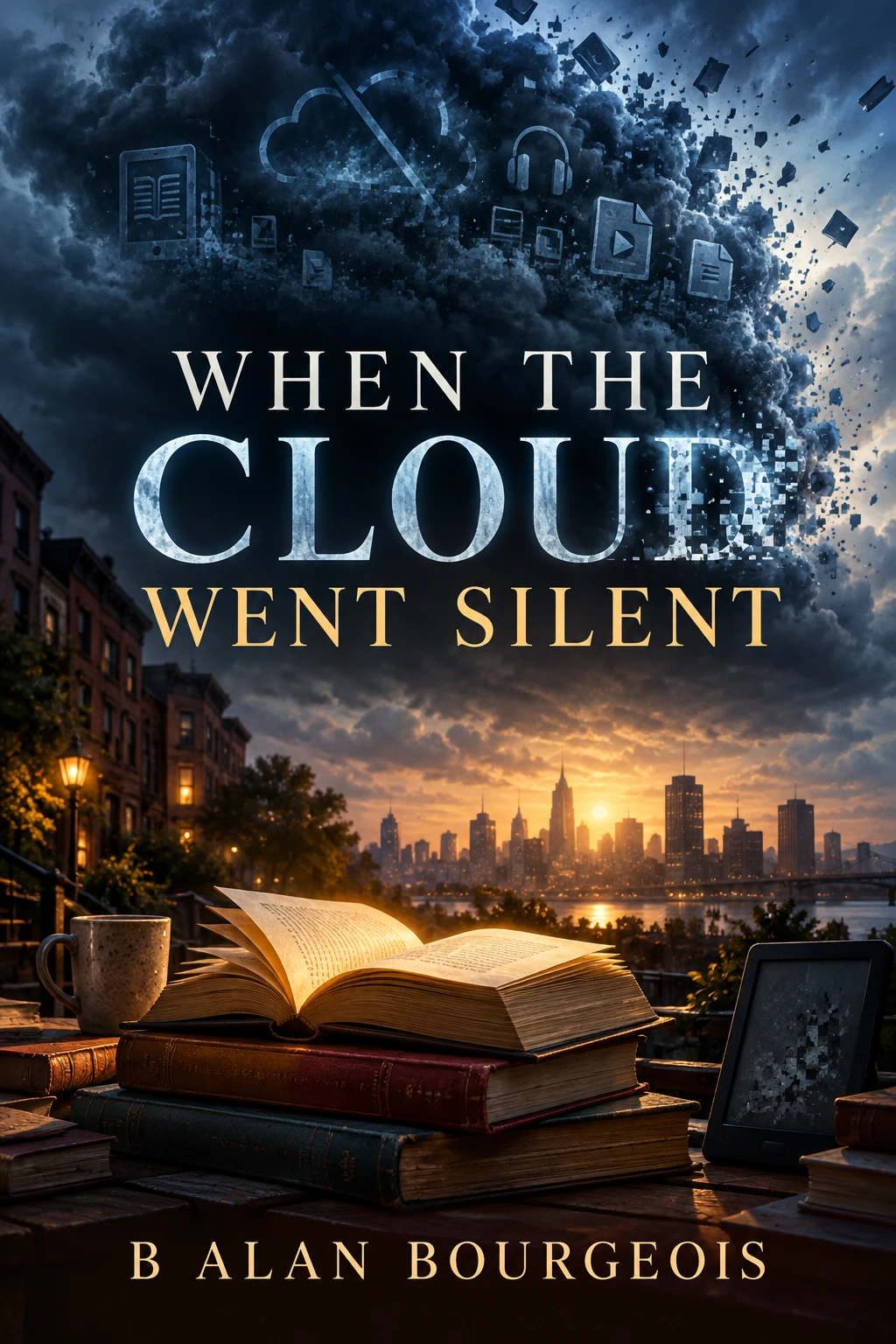
When the Cloud Went Silent
Ready to Read It?
Use the button or the permanent True Voice Review purchase link.
TrueVoiceReview.com/b/whencloud Scan to Buy the Book
Quick Take
B Alan Bourgeois delivers a provocative, accessible speculative story about technological collapse, creative ownership, and the determination of authors and communities to rebuild publishing beyond the cloud.
Short Review
In When the Cloud Went Silent, B Alan Bourgeois imagines a near-future disaster in which a coordinated attack destroys much of the world's cloud infrastructure, leaving millions of authors without access to their books, income, or publishing records.
At the center is Nora Vale, a successful mystery novelist whose professional life disintegrates when digital platforms fail. Her books disappear from electronic libraries, royalty payments become unverifiable, and a completed manuscript appears permanently lost. As publishers struggle and counterfeit editions circulate, the distinction between owning creative work and merely accessing it becomes painfully clear.
Bourgeois delivers the crisis in direct, readable prose, moving from one author's experience to the widespread consequences for the publishing industry. The story effectively explores technological concentration, digital piracy, artificial intelligence, and the vulnerability of creative livelihoods.
Its strongest development is the emergence of a cooperative publishing movement built around physical books, transparent accounting, documented ownership, and community distribution. The characters' practical efforts to rebuild provide an engaging alternative to the familiar science-fiction expectation that another technological breakthrough will solve everything.
The narrative favors ideas and social transformation over intricate characterization or sustained action. Some readers may also find its criticism of centralized digital systems unusually explicit. Yet the story's accessibility and constructive approach help distinguish it from conventional technological dystopias.
When the Cloud Went Silent is particularly well suited to readers interested in books, independent publishing, technology ethics, and economic resilience. Its lasting strength lies in an unsettling proposition: a society may possess unprecedented access to information while remaining dangerously uncertain about what it actually owns.
Full Review
When the Cloud Went Silent by B Alan Bourgeois presents a frighteningly plausible question: What happens when the systems entrusted with preserving literature, distributing books, and paying authors suddenly disappear—and never fully return?
Rather than imagining a distant future filled with advanced machines or unfamiliar civilizations, Bourgeois constructs a technological catastrophe from dependencies already embedded in contemporary life. The result is a compact, socially conscious work of speculative fiction that challenges assumptions about digital ownership, technological permanence, and the economic survival of creative professionals.
The story opens with a deceptively ordinary moment. Nora Vale, an established mystery novelist, is making coffee while listening to an audiobook when the narration abruptly stops. Within minutes, her digital library begins disappearing, followed by access to her publishing accounts, manuscripts, and financial information. What initially resembles a temporary service disruption rapidly develops into a worldwide emergency.
Data centers across multiple continents have been disabled through a coordinated attack. Their failure triggers the collapse of interconnected systems supporting electronic publishing, financial transactions, artificial intelligence, and digital commerce. The disaster is not simply that computers stop functioning. The deeper catastrophe is that society has entrusted essential records, creative property, and economic relationships to infrastructure that can no longer establish what belongs to whom.
Bourgeois makes this crisis personal through Nora's experience. Having published eighteen novels and sold hundreds of thousands of copies, she discovers that professional achievement offers little protection when her books, sales records, and royalty payments become inaccessible. Her unfinished future is equally vulnerable: the completed manuscript of her nineteenth novel exists only in a synchronized digital folder.
This contrast between apparent ownership and actual control forms the story's central argument.
One of the narrative's greatest strengths is its treatment of the publishing industry as an interconnected economic ecosystem rather than merely a collection of authors and readers. Bourgeois recognizes that the disappearance of electronic books would also affect narrators, editors, publishers, distributors, libraries, and independent booksellers. Royalty accounting, audience relationships, marketing infrastructure, and copyright verification become casualties of the same technological breakdown.
The story also addresses concerns surrounding artificial intelligence and the unauthorized reproduction of creative work. Counterfeit editions, imitative novels, and synthetic narrations complicate an already devastated marketplace. These elements broaden the crisis beyond technological dependency to questions about authorship, identity, and the protection of human creativity.
Bourgeois adopts a direct, economical prose style that prioritizes clarity and consequences over decorative language. Short paragraphs and restrained dialogue contribute to the immediacy of the opening sections. The language remains accessible even when describing compromised infrastructure, destroyed authentication systems, and disrupted supply chains.
The structure moves chronologically, beginning with the initial collapse and extending through the longer struggle to establish alternatives. This progression gives the narrative the character of a speculative social history, following an individual crisis into a broader transformation of the publishing economy.
Its most compelling human relationship emerges when Nora encounters Evelyn Shaw, an experienced printer whose practical understanding of physical production becomes essential to survival. Evelyn's insistence on verifiable orders, usable resources, and functioning equipment provides an effective counterweight to the technological promises that previously governed the industry.
Their interactions help transform the story from a disaster narrative into an examination of community resilience.
The establishment of the Lantern Cooperative introduces a hopeful dimension without suggesting that rebuilding is easy. Scarce materials, production expenses, distribution difficulties, and financial uncertainty remain significant obstacles. Bourgeois gives particular attention to the practical mechanics of recovering printed books, documenting ownership, preserving records, and developing local economic networks.
This operational detail distinguishes the story from speculative fiction that resolves technological disaster through a convenient invention or sudden restoration of centralized authority. The alternative presented here depends on human cooperation, transparency, and sustained labor.
The environmental considerations surrounding paper production provide another layer of credibility. Rather than presenting printed books as inherently sustainable, the narrative acknowledges material consumption and the importance of documented sourcing, repair, reuse, and responsible manufacturing.
Importantly, the work does not entirely reject technology. Its underlying distinction is between using technological systems and surrendering exclusive control to them. This nuance also appears in its recognition that accessible reading formats remain essential, particularly for people unable to use conventional printed books.
The story's limitations arise primarily from its ambitious scope and purposeful message. Readers seeking an extended psychological portrait of Nora or a sustained thriller about the perpetrators of the attack may find those elements secondary. Several developments are presented through broad narrative summaries rather than fully dramatized scenes. The multinational consequences of the disaster also unfold with remarkable coordination, leaving relatively little room for competing political, economic, or cultural responses.
Likewise, the story's criticism of centralized technology and automated creative production is unmistakable. Readers who prefer speculative fiction that maintains greater ambiguity about its social arguments may find its advocacy-oriented approach more pronounced than expected.
Nevertheless, Bourgeois succeeds in creating a thought-provoking narrative whose strongest moments emerge from ordinary objects and recognizably human choices. A surviving printed manuscript, a working press, a verifiable transaction, and a book placed directly into a reader's hands acquire unexpected emotional importance.
When the Cloud Went Silent is ultimately less concerned with the destruction of technology than with the recovery of agency. It asks readers to distinguish convenience from security, distribution from ownership, and storage from preservation.
For readers interested in publishing, technological vulnerability, creative rights, and community self-reliance, this is an accessible and timely cautionary story with a constructive vision at its center.