
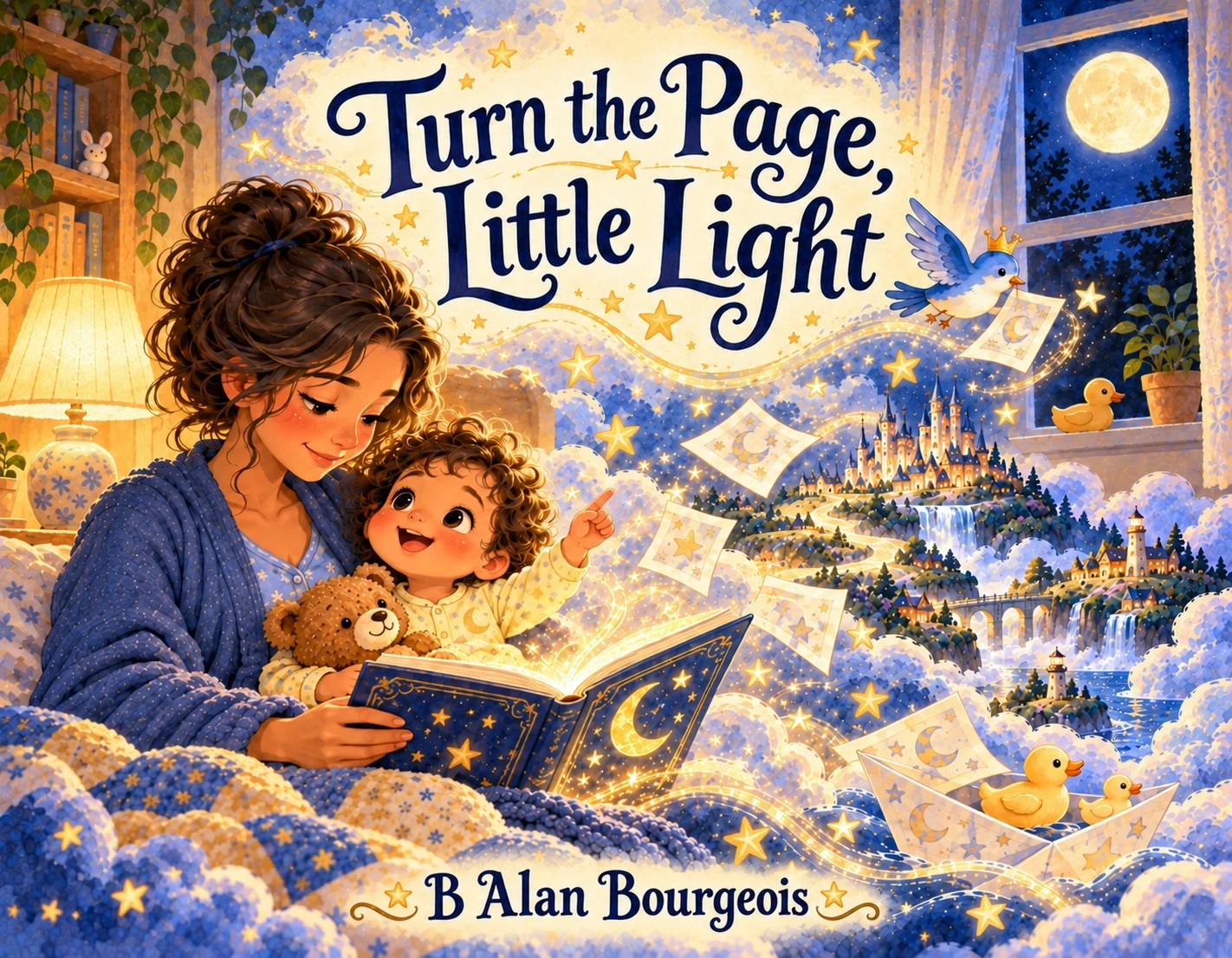
Turn the Page Little One
Ready to Read It?
Use the button or the permanent True Voice Review purchase link.
TrueVoiceReview.com/b/turnpage Scan to Buy the Book
Quick Take
It gives caregivers and young children a warm setting for that exchange. Its appeal rests in making the ordinary act of reading together feel worthy of wonder.
Short Review
B Alan Bourgeois’s Turn the Page, Little Light celebrates bedtime reading through the experiences that reach a child before written words do: a familiar voice, a comforting touch, and pictures worth pointing at. Addressed by a caregiver to a young listener, the lyrical text moves gently between a shared bedroom and an imagined world of book-boats, crowned birds, and yellow ducks.
The book’s strongest insight is that very young children already participate in stories through rhythm, recognition, laughter, and affection. Its repeated refrain invites familiarity, while short lines and gentle rhyme give adults room to read with a soft, musical cadence.
The illustrations pair deep blues and lavender with warm gold, carrying recurring bedroom details into expansive cloud-filled scenes. Alternating text pages and full illustrations create a predictable reading pattern. Large lettering against pale backgrounds keeps the short passages readily distinguishable from their decorative borders.
The artwork’s abundance may invite exploration more readily than sleep: stars, glowing trails, toys, and patterned surfaces fill many pages. Likewise, children seeking a developing plot may find the repeated reassurance less engaging than younger listeners do.
Best suited to shared reading with toddlers and younger preschoolers, this affectionate picture book offers a welcoming ritual of closeness and imagination. Its appeal rests in making the ordinary act of reading together feel worthy of wonder.
Full Review
A shared book, a familiar voice, and the comfort of being held give Turn the Page, Little Light its gentle center. B Alan Bourgeois’s picture book treats bedtime reading as an experience that begins before a child can recognize words. Its young listener understands touch, rhythm, pictures, and affection first. From that simple premise comes a lyrical invitation to slow down together while imagination carries the bedroom into a moonlit world.
The book takes the form of a caregiver’s address to a small child. There is no conventional problem to solve or adventure to complete. Instead, the movement is from waking attention toward rest, with a book providing the passage between them. A mother and child appear throughout the illustrations, while the text’s direct address allows the words to be spoken naturally by another trusted reader. The emotional stakes are deliberately small and immediate: remaining close, enjoying another rhyme, and allowing the day to recede.
One of the text’s most appealing observations concerns the child who cannot yet speak the words but already recognizes their musical pattern. That acknowledgment gives the book a thoughtful understanding of its youngest audience. Listening is presented as participation. Pointing, laughing, and trying to kiss the pictured ducks belong to the reading experience as fully as speaking does. The child is an active companion in the ritual, even while the adult supplies the language.
The recurring invitation to turn the page provides a recognizable refrain. Short lines, gentle rhymes, and repeated phrases give the reading a songlike shape, while references to floating, blue skies, and expanding dreams support its drifting mood. Most of the language is straightforward enough to follow by sound and context. The metaphor of the child as a little light adds affection without requiring an explanation. The words are most effective when they remain close to physical experience: fingers finding a hand, a blanket, a book, and an unhurried voice.
The illustrations extend those familiar comforts into elaborate fantasy. Deep blues, lavender tones, creamy clouds, and warm golden light connect the bedroom with scenes of floating books and moonlit travel. The recurring quilt, patterned with blue and yellow squares, helps hold the domestic setting together. Mother and child remain the visual anchors as the surrounding world becomes more expansive. Books acquire the possibilities of boats, and familiar bedtime objects become part of a landscape that seems made for dreaming.
The alternation between text pages and full illustrations establishes a predictable pace. Large, dark lettering sits against pale centers, framed by decorative clouds, stars, moons, books, and toys. The arrangement gives the reader room to pause over a short passage before exploring its accompanying image. The illustrated pages offer details to notice together, including ducks, a crowned bird, and a bear associated with the book’s imaginative play. This makes the volume suitable for both a quiet straight-through reading and a slower exchange of pointing and naming.
Its visual richness also creates a qualification. The pages are often densely ornamented, with luminous trails, patterned bedding, floating objects, and numerous stars competing for attention. Some children will enjoy that abundance; others may find it more stimulating than soothing. The repeated decorative borders unify the design, but they also make several text pages look very similar. The book’s bedtime effectiveness will depend partly on whether a child settles through visual familiarity or prefers a sparer page.
The writing has a comparable tradeoff. Repetition supports reassurance and recognition, though the book offers limited narrative development for listeners who want surprises or a clear sequence of events. Its rhythm is broadly musical rather than uniformly metrical, leaving the adult reader to shape some pauses and emphases. These qualities place it most comfortably among lyrical bedtime books for shared reading, particularly with toddlers and younger preschoolers.
The closing invitation to read with a companion song reinforces the book’s musical identity, although the printed text stands on its own. Ultimately, Turn the Page, Little Light succeeds through its understanding that a bedtime book can offer companionship as much as a story. Its strongest promise is the pleasure of being attended to. With affectionate language and a coherent blue-and-gold dream world, it gives caregivers and young children a warm setting for that exchange.
Pull Quotes
Content Notes
Language: Gentle, child-friendly language; no profanity or slurs.Violence: None.Sexual Content: None; affectionate caregiver-child closeness.Drugs/Alcohol: None.Sensitive Topics: No significant sensitive material. Nighttime and dream imagery are warm and reassuring, without threatening scenes.