
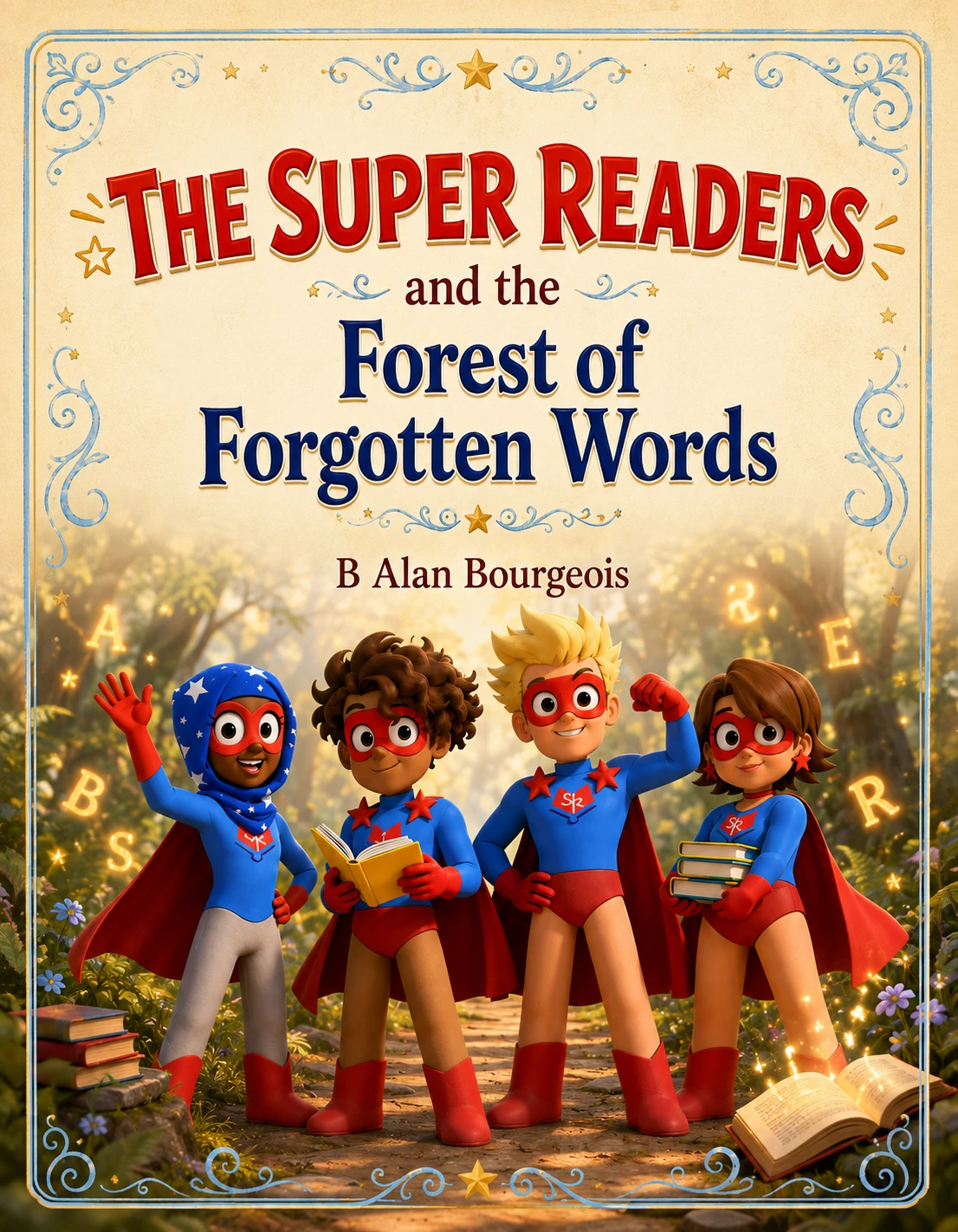
The Super Readers
Ready to Read It?
Use the button or the permanent True Voice Review purchase link.
TrueVoiceReview.com/b/superreaders Scan to Buy the Book
Quick Take
The Super Readers and the Forest of Forgotten Words transforms reading, empathy, language, and imagination into genuine superpowers in a beautifully illustrated adventure about restoring both a forest and its voice.
Short Review
The Super Readers and the Forest of Forgotten Words turns reading and empathy into superhero abilities in a colorful children's adventure centered on four friends: Osie, Amal, Bruce, and Ampy. Each contributes something different—knowledge, emotional understanding, imagination, or language—and their abilities become essential when Whispering Woods mysteriously begins losing its words.
The mystery leads to Mina, a girl whose word-collecting machine has accidentally taken far more than she intended. Rather than treating her as a villain, the Super Readers respond with curiosity and compassion. Amal's Heart-Sight helps Mina understand how the disappearing words have affected the forest's animals and habitats, while the others use books, language, and imagination to repair the damage.
The book's greatest strength is its ability to make literacy feel active. Reading supplies knowledge. Listening builds understanding. Words carry consequences. Imagination creates solutions.
Its elaborate full-page illustrations are also central to the experience, shifting from warm, inviting Library Hill scenes to darker woodland mystery and finally to a vividly restored forest. Younger readers are likely to respond strongly to the superhero presentation and repeated phrases, although older children may find the plot deliberately simple.
This is a warm, accessible picture-book adventure for families, schools, libraries, and literacy programs looking for a story that celebrates reading without feeling like a reading lesson.
Full Review
The Super Readers and the Forest of Forgotten Words is a brightly illustrated children's fantasy-adventure built around a simple but effective idea: reading, empathy, imagination, and communication are not merely school skills—they can function like superpowers.
The story introduces four young heroes who live together in a house shaped like a book on Library Hill. Each possesses a different reading-related ability. Osie can temporarily absorb and apply knowledge from books; Amal possesses “Heart-Sight,” which helps willing participants understand another person's feelings; Bruce uses imagination and a silver quill to transform clues into stories and plans; and Ampy can read rapidly, understand languages, and sometimes even communicate with animals. Together they form the Super Readers, united by curiosity and a readiness to help.
That concept gives the book an immediate advantage with younger readers. Instead of telling children that reading is important because adults say so, the story dramatizes literacy as power. Osie's central rule—read, learn, and then use what has been learned—makes knowledge active rather than passive. Amal's Heart-Sight provides an equally important emotional counterpart. She cannot force kindness; she can only create an opportunity for understanding. That limitation keeps her ability from becoming a convenient magical solution and reinforces the book's larger idea that empathy still requires choice.
The adventure begins when the four friends venture into Whispering Woods and discover something deeply wrong: the normally lively forest has become unnaturally silent. A frightened rabbit eventually explains the problem through Ampy—the woods are “losing its words.” Soon the children discover letters disappearing from signs, leaving names and directions incomplete and animals confused. The visual presentation makes this concept especially effective, with glowing letters physically drifting away from wooden signs and through the darkening forest.
The source of the problem is not a conventional villain. Instead, the Super Readers discover Mina, a girl who created a strange word-collecting machine. She wanted to gather words but accidentally allowed the machine to collect far too many. This choice is one of the book's strongest storytelling decisions. Rather than defeating a bad person, the heroes must understand a person who made a mistake.
Amal takes the lead emotionally. Mina expects anger, but Amal instead offers understanding and explicitly gives Mina a choice about using Heart-Sight. Through that experience, Mina begins to feel the consequences of what she has done: frightened animals, displaced birds, damaged habitats, and a forest that is not simply a collection of trees but an interconnected world of homes, paths, water, animals, and stories.
From there, the four Super Readers solve different parts of the problem according to their individual strengths. Osie reads about forest recovery and applies what he learns. Ampy discovers that the machine is not malfunctioning at all—it is faithfully obeying the command “COLLECT,” making the solution elegantly simple: change the instruction to “RETURN.” Bruce then recognizes that replacing the physical letters is not enough; the forest also needs its story restored. This cooperative structure reinforces the idea that intelligence has different forms and that difficult problems are often solved by combining them.
The visual design is a major strength. The book uses polished, cinematic fantasy illustrations, expressive child characters, glowing magical lettering, richly detailed woodland environments, and clear shifts between the warm safety of Library Hill and the shadowy mystery of Whispering Woods. Pages such as the restored forest scene emphasize renewal visually as strongly as the text does, while later activity-style pages extend the characters beyond the immediate story.
The prose is intentionally simple, rhythmic, and highly readable aloud. Short repeated phrases—particularly the forest sounds and the individual Super Reader principles—give younger listeners natural points of participation. The tradeoff is that older independent readers may find the story straightforward, and characterization remains primarily defined by each hero's special ability rather than by deeper individual conflict. As the first volume of a series, however, that simplicity functions reasonably well as an introduction.
The ending completes the book's educational purpose without becoming punitive. The Super Readers and Mina restore the woods together; letters, animals, families, and stories return. The final “Super Reader Pledge” extends the story's ideas into the child's own world, emphasizing wonder, courage, listening, kindness, helping, language, and imagination.
For parents, teachers, librarians, and children who enjoy superhero imagery but want something gentler and more literacy-centered than action-heavy comic adventures, The Super Readers and the Forest of Forgotten Words offers an appealing combination of fantasy, environmental awareness, emotional literacy, and the simple pleasure of books themselves.
Pull Quotes
Content Notes
Language: None; clean, child-appropriate language.
Violence: None. Mild suspense involving a damaged forest and worried animals.
Sexual Content: None.
Drugs/Alcohol: None.
Sensitive Topics: Mild environmental harm, frightened animals, temporary loss of animal habitats, and a child coping with having accidentally caused damage. These elements are handled gently and resolved positively.