
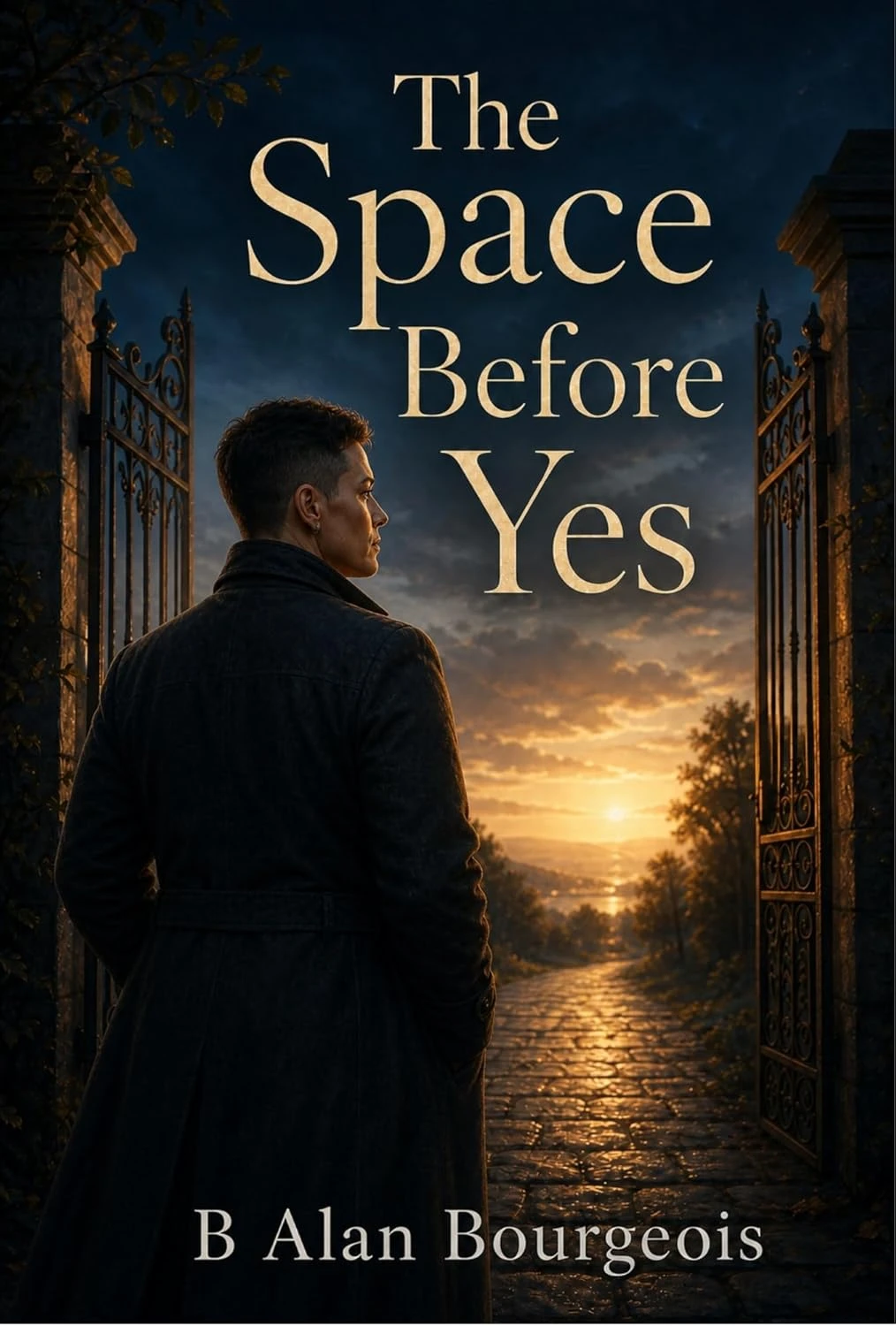
The Space Before Yes
Ready to Read It?
Use the button or the permanent True Voice Review purchase link.
TrueVoiceReview.com/b/spacebefore Scan to Buy the Book
Quick Take
A lyrical, politically urgent, and deeply humane speculative novel about identity, consent, and the sacred discipline of seeing another person without trying to own them.
Short Review
The Space Before Yes is a powerful speculative novel about identity, consent, and the danger of systems that mistake classification for truth. Set in a near-future America where citizens must undergo government-backed biological verification, the story begins with Reese Bell, a butch lesbian, facing a machine designed to define her. When the machine produces an impossible result, the moment exposes not only the system’s failure, but the larger human cost of being reduced to a category.
Narrated by Miles Vale, an older gay man and longtime friend of Reese, the novel carries the weight of memory, grief, humor, and hard-earned moral clarity. Reese is the heart of the book: guarded, funny, wounded, stubborn, and deeply human. Her presence keeps the story emotionally grounded even as the premise expands into questions of law, faith, technology, testimony, and public resistance.
The prose is lyrical and reflective, with a strong rhythm that often feels like testimony or moral witness. Readers looking for fast-paced dystopian action may find the book more meditative than suspense-driven, and its political message is direct. But for readers who appreciate character-driven speculative fiction with emotional depth and social urgency, this is a memorable and moving work.
At its core, The Space Before Yes is not simply about being seen. It is about the ethics of asking, waiting, listening, and refusing to turn another person’s life into evidence.
Full Review
The Space Before Yes is a speculative, politically charged, deeply human novel about identity, consent, state power, and the sacred space between seeing another person and claiming authority over them. The story opens in a Civic Identity Verification Center, where citizens are being forced through a government-backed system designed to reduce human identity to official biological classification. That premise could easily become a blunt political allegory, but the novel finds its power by grounding the larger conflict in one unforgettable human moment: Reese Bell, a butch lesbian whose life has been shaped by being misread, questioned, categorized, and corrected, steps before a machine built to define her—and the machine cannot contain what it sees.
The novel is narrated by Miles Vale, an older gay man whose voice carries history, grief, humor, weariness, and moral clarity. Miles is not merely an observer; he is a witness, and the difference matters. Through him, the book becomes less about a futuristic technology than about the long record of people being forced to justify their existence to institutions that mistake paperwork for truth. His narration gives the novel its reflective force. He understands the political stakes, but he also understands the emotional cost of living through decades of moral panic, bureaucracy, and selective compassion.
Reese is the book’s strongest creation. She is funny, guarded, practical, wounded, defiant, and profoundly believable. Her sarcasm keeps the story from becoming overly solemn, while her emotional restraint makes the moments of vulnerability hit harder. The early scenes establish her immediately as someone who has spent a lifetime surviving other people’s certainty. She does not need the machine to validate her, but the machine’s failure exposes the absurd cruelty of a system that demands validation in the first place. That tension gives the novel its central moral engine.
The supporting cast broadens the story without pulling attention away from its core. Amari brings youthful fear and tenderness into the opening conflict. Callum Cross, a technician whose conscience begins to crack open, provides a useful point of entry for readers watching someone inside the system begin to see the system clearly. Figures such as June, Tull, Pastor Livia, Priya, Dana, and Felix deepen the novel’s landscape as the story moves beyond one room and into testimony, shelter, public pressure, law, faith, and communal care. The story’s structure expands from an intimate bureaucratic confrontation into something larger, but its best passages remain those that return to touch, permission, naming, grief, and the right not to be taken from.
The prose is polished, lyrical, and often striking. Bourgeois writes in short, rhythmic movements that give many passages the force of spoken testimony. The style leans heavily on repetition, contrast, and aphoristic reflection: law versus consent, seeing versus looking, classification versus recognition, witness versus savior. At its best, this creates emotional momentum and gives the novel a memorable, almost sermon-like cadence. Readers who enjoy reflective literary speculative fiction will likely find the voice compelling and resonant.
That same style may also be the book’s main limitation for some readers. The novel is more meditative than action-driven. Its dramatic premise carries thriller-like possibilities, but the story is less interested in chase scenes or procedural suspense than in moral awakening, testimony, and interior reckoning. Some readers may find the philosophical passages repetitive or the political framing too direct. Others will see that directness as the point. This is not a neutral book, nor is it trying to be. It is a novel with a clear moral position: no institution, technology, law, church, movement, or lover has the right to define a person by force.
The book’s speculative element is especially effective because it does not over-explain itself. The “human signal” and the later language of consent could have become mechanical world-building, but the novel treats them as mystery, revelation, and ethical challenge. The result gives the story a spiritual dimension without fully abandoning its political and social grounding. The strongest idea in the book is not that a machine discovers the soul; it is that even a machine built for control begins to recognize that interpretation without consent is violation.
The ending wisely avoids simple triumph. The story does not pretend that one event fixes the machinery of power. Instead, it offers something quieter and more durable: permission, witness, friendship, restraint, and the ongoing discipline of not taking what has not been freely given. That restraint gives the book its title and its emotional afterlife.
The Space Before Yes will speak most strongly to readers drawn to LGBTQIA+ fiction, speculative social commentary, literary dystopian fiction, and stories about bodily autonomy, identity, faith, and resistance. It is thoughtful, compassionate, sharp-edged, and emotionally sincere. Its politics are unmistakable, but its deepest concern is not ideology. It is the question of how one human being approaches another without turning recognition into possession.
Pull Quotes
Content Notes
• Language: Moderate language, including occasional profanity and reclaimed slurs in LGBTQIA+ context.
• Violence: Mild to moderate; more institutional, emotional, and political than graphic physical violence.
• Sexual Content: Minimal; references to relationships, desire, identity, and intimacy, but no explicit sexual scenes.
• Drugs/Alcohol: Mild references; not a major content element.
• Sensitive Topics: Strong themes involving anti-LGBTQIA+ discrimination, state surveillance, forced classification, family rejection, religious/political hostility, trauma, grief, and bodily autonomy.