
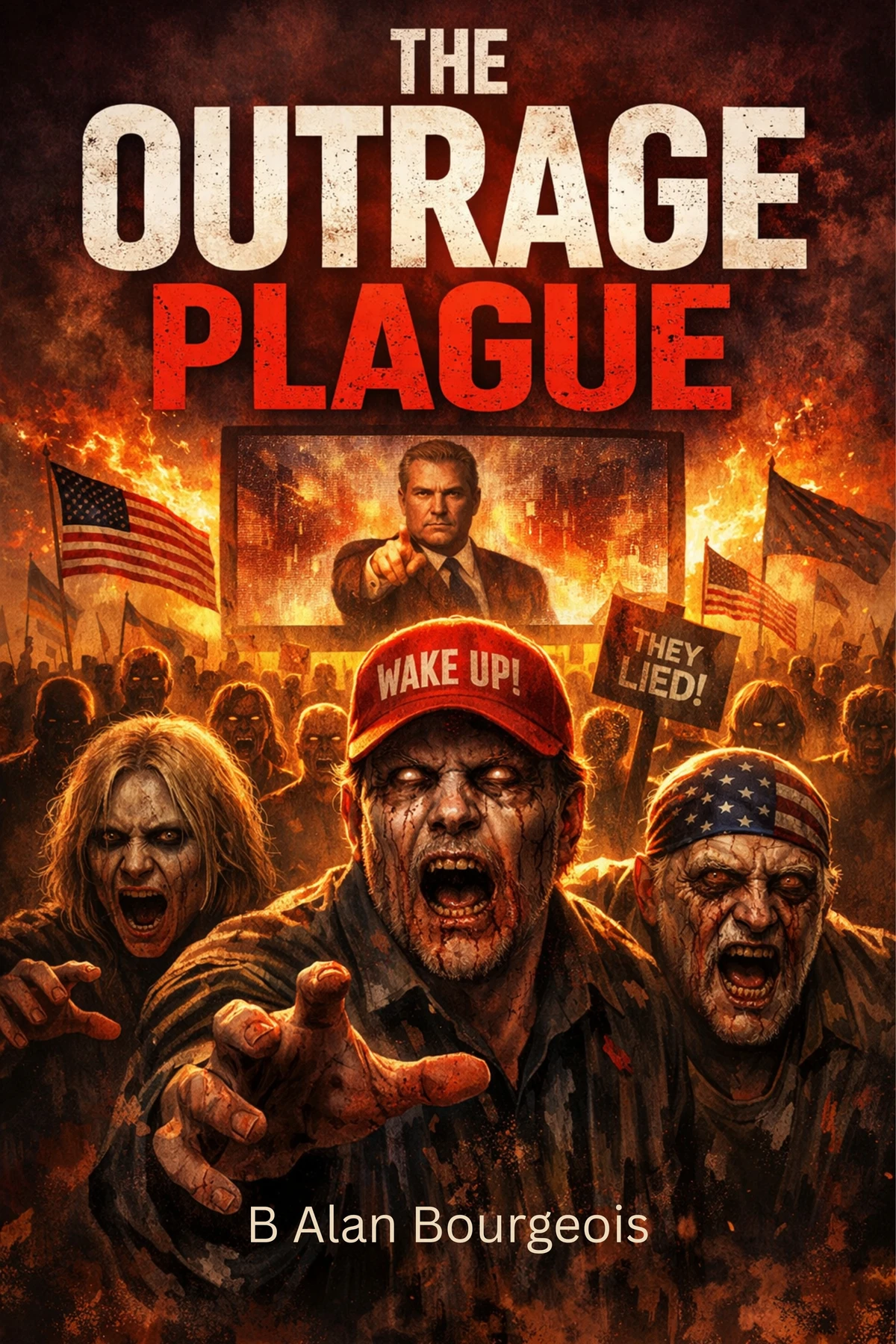
The Outrage Plague
Ready to Read It?
Use the button or the permanent True Voice Review purchase link.
TrueVoiceReview.com/b/outrageplagu Scan to Buy the Book
Quick Take
A blistering small-town thriller that turns algorithmic outrage into literal contagion, following a local editor and a nurse sister as a “truth” feed rewires neighbors into coordinated, slogan-spitting predators.
Short Review
The Outrage Plague is a political-horror satire that literalizes algorithmic outrage into a contagious, zombie-like state. In a small county where truth has become negotiable, newspaper editor Cal Reese watches a new feed called Pulse spread at lightning speed—less as “misinformation” than as coordinated emotional programming. A charismatic local agitator, Gideon Vale, gives the town a story that feels like relief: you’ve been lied to, your pain has a target, and certainty is proof of being “awake.”
Cal’s attempt to correct a viral lie makes him a marked man, while his sister June—a hospital nurse—sees the phenomenon at ground level as assaults, chanting, and patients whose bodies react to the feed like it’s a drug. The book’s tension comes from a chilling escalation: the “zombies” aren’t undead; they’re overridden, reduced to slogans and commands, and driven toward violence by the next instruction.
Written with fast pacing, headline-sharp language, and escalating set pieces, the novel will click with readers who enjoy social commentary embedded in thriller momentum and horror imagery. Readers who prefer subtle allegory or who want the tech elements to stay strictly realistic may find some turns deliberately heightened. Overall, it’s an angry, urgent, and darkly entertaining warning about what happens when attention becomes the point of capture.
Full Review
The Outrage Plague takes a familiar modern phenomenon—algorithm-fed political fury—and pushes it past metaphor into body horror. The opening “turn” happens in a discount grocery store, where a church-volunteer grandmother figure named Darlene goes glassy-eyed, labels a stranger “Traitor,” and bites with eerie efficiency. The footage is instantly clipped, captioned, reframed, and sold back to the public in a thousand weaponized versions. That sequence establishes the book’s governing idea: reality no longer spreads by being true; it spreads by being usable.
At the center is Cal Reese, a small-town newspaper editor trying to keep a dying local paper meaningful in a town that’s stopped agreeing on basic facts. Cal isn’t written as a hero with a grand plan—he’s an observer by trade, someone trained to translate civic life into something readable. That makes him the right lens for a story about readability collapsing. His most “reasonable” act—posting a calm correction with full context—doesn’t defuse the lie. It turns him into a target. The responses aren’t arguments; they’re chants. And the repetition is the first real symptom.
The engine of the plague is Pulse, a new “truth” feed that behaves less like a platform and more like a slot machine tuned to adrenaline. Pulse doesn’t merely misinform; it coordinates. The book’s sharpest satirical touch is how quickly the town’s language becomes standardized—rhythm, cadence, phrasing—until it feels like many bodies speaking with one mouth. The antagonistic force isn’t just ideology; it’s the delivery mechanism: a system that trains people to experience rage as clarity and certainty as relief.
Gideon Vale, the movement’s charismatic nucleus, embodies that mechanism in human form. He’s part preacher, part influencer, part political accelerant—filmed and framed to look inevitable. Vale’s appeal is written with unnerving accuracy: he offers a simple story that flatters the audience (“you’re not stupid, you’re awake”) while giving their frustration a target. The book understands a hard truth about propaganda: it doesn’t have to be smart; it has to be satisfying.
Cal’s strongest counterpart is his sister June, a nurse at the local hospital who has no patience for euphemism because she’s the one cleaning up the consequences. Through June, the story gains a practical, medical texture: assaults, spikes in vitals, patients narrating their own victimhood to their phones, and the creeping realization that the “zombie” state isn’t theatrical—it’s behavioral capture. The horror lands because it’s incremental. People don’t become monsters by dying; they become monsters by being overridden.
Stylistically, the prose is brisk, visual, and rhythm-driven—built for momentum and for dread. The book leans into clipped slogans, headline fragments, and comment-thread liturgy, then contrasts that with Cal’s steadier, more observational reporting voice. That tension is productive: it lets readers feel how the feed’s language colonizes thought. Structurally, the book plays like a propulsive thriller with episodic set pieces (public incidents, hospital escalations, street-level confrontations) that keep raising the stakes while widening the frame from “town conflict” to “systemic contagion.”
The novel’s themes are blunt by design: outrage as addiction, attention as a battlefield, and the monetization of fear as a public-health crisis. It’s also an unusually clear-eyed critique of “fact-checking” as a standalone solution; the story insists that evidence isn’t a spell that breaks enchantment. The plague is affective before it’s intellectual—felt in the body, reinforced by community, and rewarded by the feed.
That directness will be a feature for readers who want their social horror sharp-edged and explicit. It may be a limitation for readers who prefer ambiguity, quieter allegory, or ideological distance. The story also takes big swings with the tech-and-biochemistry elements, and some readers will read those turns as heightened speculation rather than plausible near-future extrapolation. But as a piece of satirical horror with a thriller spine, The Outrage Plague succeeds where it aims: it turns the scrolling mind into a haunted house, then makes the exit feel earned rather than easy.
Pull Quotes
Content Notes
• Language: Mild to moderate; frequent charged rhetoric/slogans; occasional profanity.
• Violence: Moderate; assaults, biting, mob aggression, and threat-driven scenes; not lingered on as graphic gore.
• Sexual Content: None.
• Drugs/Alcohol: Minimal; references are brief and not central.
• Sensitive Topics: Political extremism, mass hysteria/coordination, harassment and threats, medical crisis settings, fear-based propaganda, civic breakdown.