
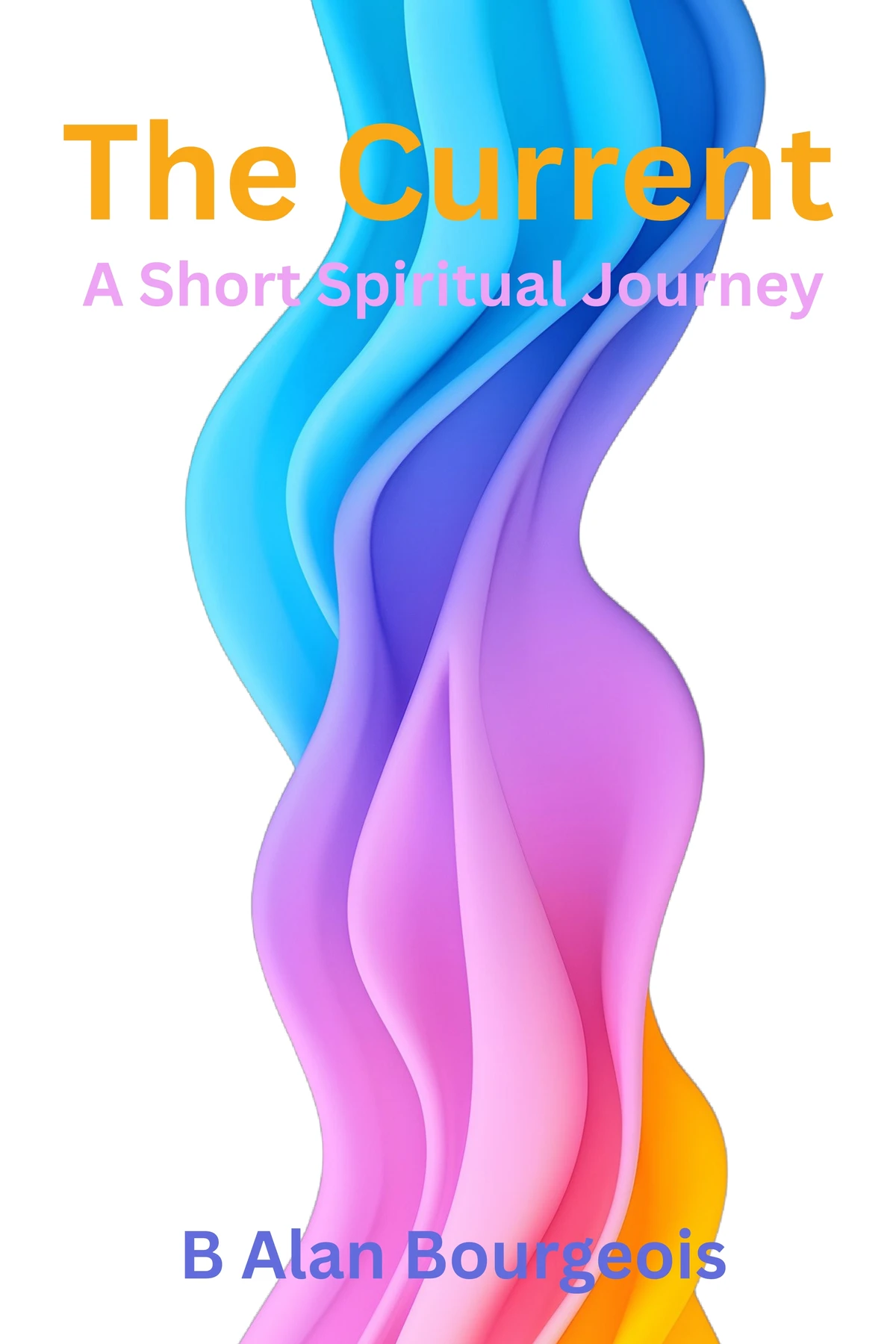
The Current
Ready to Read It?
Use the button or the permanent True Voice Review purchase link.
TrueVoiceReview.com/b/current Scan to Buy the Book
Quick Take
The Current is a tender, quietly intense queer spiritual novel that turns grief, desire, art, and community service into a deeply embodied journey from numbness to fully lived, interconnected presence.
Short Review
The Current is a contemplative, queer spiritual novel that begins at a friend’s funeral and follows Adrian, a man who realizes he has been “skimming” his life, as he commits to feeling every moment in his body. Bare feet in wet grass, potatoes in a diner, brushes softened in soapy water, and volunteer shifts at a food pantry all become doorways into a new way of being. Along the way, a gentle relationship with Elias models desire as a patient current rather than a compulsive escape. The prose is vivid and poetic, the structure organized into movement-like chapters that map a spiritual arc from grounding through collapse to integration and quiet presence.
This is a book of interior stakes and slow revelations rather than big plot twists. Readers who want action-driven drama may find its pacing deliberate, but those who value sensory detail, emotional honesty, and nuanced queer spirituality will likely find it deeply resonant. The Current ultimately offers an unhurried, embodied vision of awakening—one where grief becomes union, service becomes prayer, and everyday contact becomes the place where the sacred lives.
Full Review
The Current follows Adrian, a competent, self-contained gay man whose life cracks open at the funeral of his friend Julian. In the opening scene, a church that “smelled like wet wool and lilies” and a coffin “unhelpfully perfect” frame a quiet internal crisis as Adrian realizes he has been “skimming [his] own life.” That moment becomes the book’s core question: what happens when a man who has survived by managing, numbing, and performing finally decides to feel everything in his body, his grief, and his desire—and lets that decision reorder his entire life.
Structured in nine movement-like chapters—Ground Broken, The Stirring, Fire in the Belly, The Breaking Open, The Voice That Trembles, Night Sight, The Collapse, The Integration, The Crown, and Living the Current—the book reads like a spiritual arc mapped onto a contemporary queer life. Each chapter centers on a specific energetic shift: grounding, awakening desire, learning to hold power, opening the heart, perceiving more deeply, breaking down, and finally integrating and embodying a new way of being. A short foreword makes explicit that this is the narrative foundation for a future spiritual musical, but the story stands on its own as a compact, reflective novel of transformation.
Adrian is the clear center of the book. At first he is “handsome enough, athletic enough” and expertly armoured, moving through a life of apps, casual encounters, and polished surfaces that never quite reach his bones. Julian’s sudden death doesn’t just trigger grief; it exposes the emptiness of that performance. Adrian’s response is intensely embodied: bare feet in wet grass by the creek, a simple plate of diner potatoes treated as a “sermon the minister should have tried,” a notebook where he writes lines like “Begin” and “I am tired of only touching the surface of things.” The story follows him as he learns to stay present in his body and in his life instead of slipping back into old distractions.
A large part of that shift is mediated through two relationships: with Elias, a grounded, quietly spiritual man he first glimpses outside the funeral, and with the community around a local food pantry and clinic.
Elias is not a savior figure; he is a witness and a mirror, someone whose steadiness gives Adrian something to lean toward without surrendering his agency. Their connection unfolds slowly, through walks, shared meals, and small acts of consent. A key on-page kiss and later intimate scene emphasize slowness, presence, and mutual attunement rather than explicit erotic detail, positioning queer desire as a sacred, embodied current rather than a problem to solve.
The other major relationship is between Adrian and his city’s margins. Volunteering at the food pantry, he packs rice, beans, and canned tomatoes while watching the people who come through: a boy named Mateo learning to double-bag, an older man with “onion-skin” hands whose gratitude nearly undoes him, a woman whispering “no pork, please.” These scenes are some of the book’s strongest: they ground the interior spiritual journey in concrete acts of service and remind both Adrian and the reader that awakening divorced from community quickly becomes performance.
Stylistically, The Current is highly sensory, poetic, and meditative. The prose dwells in small moments—a clementine peeled at lunch, its scent trailing through the afternoon; new brushes softened in soapy water; watercolor washes pooling on paper; ginger tea steeping; the weight of a hand on a chest. Dreams and subtle visionary experiences, like indigo stairways and wordless bells, punctuate the narrative without tipping into full-on fantasy. The book stays in a close third-person past tense that tracks Adrian’s attention moment by moment, which gives the story an almost contemplative pacing.
That pacing and focus are both a strength and a limitation. Readers drawn to interior, spiritually-inflected literary fiction will likely find the slow burn, the attention to breath, food, and art, and the repeated mantra-like lines deeply satisfying. Those looking for high external stakes, plot twists, or conventional romance beats may find the story “quiet,” with most of the drama occurring in Adrian’s nervous system rather than in overt conflict. The chapter titled “The Collapse,” for example, is less about a single catastrophic event than about the day his newly opened heart crashes into old shame and public vulnerability at a community event, forcing him to confront how fragile his newfound equilibrium still is.
At the thematic level, the book engages grief, queer embodiment, spiritual reclamation, and service without slipping into dogma. Julian’s death haunts the narrative, but in later chapters that grief transforms into a quiet sense of union rather than resolution, including a dream where Julian returns in an ordinary kitchen and the silence between them becomes a kind of communion. Spiritual language—“current,” “light,” “crown,” “integration”—is woven through, but almost always anchored in something physical: feet against floorboards, breath in the belly, hands at work, the city’s low hum at night. By the time Adrian reaches the final movements of The Crown and Living the Current, the book has gently but firmly shifted him from chasing peak experiences to inhabiting ongoing connection: with his own body, with Elias, with Julian’s memory, and with the web of lives around him.
Overall, The Current is a quietly ambitious novel that treats queer spiritual awakening with nuance and respect. It offers a rich, embodied interior journey, a tender queer romance, and a grounded vision of service and community. Its contemplative pace and metaphor-heavy style will especially appeal to readers who enjoy character-driven stories that explore grief, desire, and transformation through the lens of everyday life.
Pull Quotes
Content Notes
• Language: Mild; no notable slurs and no sustained use of strong profanity.
• Violence: None in a physical or graphic sense; tension and “collapse” are emotional/psychological rather than violent.
• Sexual Content: Gentle queer romance with kissing and intimate touch; no explicit on-page sex or graphic description.
• Drugs/Alcohol: Casual, moderate use of wine and references to bars; no addiction or abuse arcs.
• Sensitive Topics: Death of a close friend, grief, emotional breakdown, spiritual questioning, and food insecurity/poverty encountered through community service.