
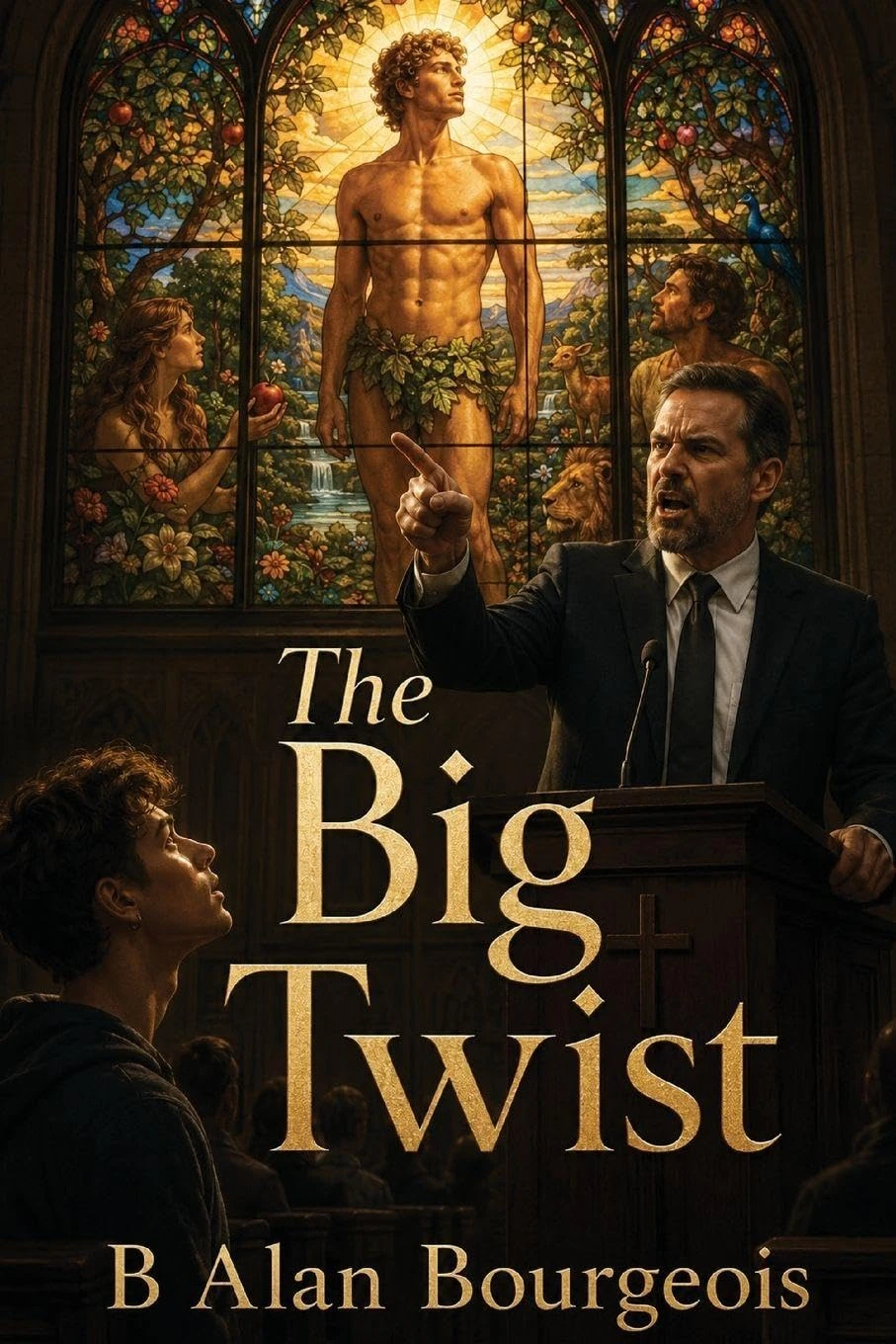
The Big Twist
Ready to Read It?
Use the button or the permanent True Voice Review purchase link.
TrueVoiceReview.com/b/bigtwist Scan to Buy the Book
Quick Take
A bold, lyrical queer reimagining of Eden that turns the fall into a story about shame, difference, love, and the sacred light creation tried to protect.
Short Review
The Big Twist: A Queer Myth of Eden is a lyrical and emotionally intelligent reimagining of the creation story, centered on Elior, a third human whose name means “God is my light.” Elior is created not as a mistake, temptation, or rival, but as another sacred expression of love, beauty, wit, emotional truth, and difference. Through him, Eden becomes more than a place of innocence; it becomes a world learning how to see.
The novella’s voice is one of its strongest assets. It combines mythic seriousness with sharp, charming humor, especially in Adam’s literal-mindedness and Elior’s graceful teasing. That lightness gives the later arrival of shame greater impact. The serpent’s role as a manipulator of comparison and division gives the familiar fall narrative a fresh emotional and theological charge.
This is not a traditional retelling, and readers looking for conventional biblical fiction may find its queer-affirming reinterpretation challenging. Its pace is reflective and theme-forward, with more emphasis on meaning, identity, and emotional revelation than on external action. For readers open to literary myth, LGBTQ+ spiritual fiction, and bold sacred reimaginings, however, The Big Twist is thoughtful, moving, and memorable.
Full Review
The Big Twist: A Queer Myth of Eden is a bold, tender, and openly revisionist novella that reimagines the Eden story through the creation of Elior, a third human made not as Adam’s rival, Eve’s replacement, or a theological loophole, but as another expression of divine intention. The manuscript frames Elior’s name as meaning “God is my light,” and that idea becomes the emotional and symbolic center of the book: difference is not a corruption of creation, but part of its original radiance.
The premise is provocative in the best sense. Rather than simply asking whether queer identity can be reconciled with faith, the novella goes further and imagines queerness as present before shame, before exile, and before religious language is twisted into exclusion. Elior enters Eden as wit, beauty, emotional intelligence, artistic perception, and sacred difference. His presence reshapes the familiar triangle of Adam, Eve, and God into something wider and more emotionally complex. Adam is earnest and literal, Eve is curious and restless, and Elior becomes the one who notices what others cannot yet say.
The book’s greatest strength is its voice. The prose blends mythic reverence with sly humor, giving the story an unusual tonal range. Adam’s bluntness, Eve’s searching mind, the peacock’s comic vanity, and Elior’s graceful teasing keep the book from becoming solemn sermonizing. That humor matters because the novella is ultimately about shame, and shame is heavy territory. By giving Eden laughter before the fall, the story makes the later emotional fracture more painful. The reader understands what is being lost: not innocence in an abstract religious sense, but ease, trust, embodiment, and the ability to see difference without fear.
Elior is especially well drawn. He is not written as a token, a lecture, or a modern person dropped awkwardly into ancient myth. He feels organically mythic while still carrying unmistakably contemporary resonance. His loneliness is handled with care: the story does not treat him as incomplete because he lacks a romantic partner, and that distinction gives the novella emotional maturity. When companionship later enters the story, it reads as abundance rather than repair. That is one of the book’s strongest thematic choices.
The serpent also works well as a force of distortion rather than simple cartoon evil. The temptation here is not merely appetite or disobedience; it is comparison. The serpent understands that shame can turn knowledge against love. That framing gives the forbidden fruit a fresh purpose. In this version, the fall is not only about breaking a rule. It is about learning to measure, categorize, blame, and look at another person’s difference as a threat. The result is a retelling that feels both ancient and painfully current.
The novella will speak most strongly to readers who enjoy literary biblical retellings, LGBTQ+ affirming fiction, mythic fantasy, and spiritually engaged stories that challenge inherited doctrine. It is not trying to be neutral theology, and readers looking for a traditional devotional interpretation of Genesis will likely resist it. The book announces itself clearly as fictional, mythic, symbolic, and transformative rather than a formal theological argument, which is important for setting expectations.
Some readers may find the book’s message very direct. The themes of queer belonging, religious shame, sacred difference, and the misuse of doctrine are not subtle background elements; they are the heart of the work. The prose can also be lush and reflective, slowing the pace in places for emotional and philosophical exploration. For readers who prefer plot-driven fantasy or restrained prose, that style may feel expansive. For the right audience, however, that same richness will be the appeal.
What makes The Big Twist stand out is that it does not merely defend queer existence; it imagines queer existence as woven into creation before condemnation ever had a vocabulary. That is a powerful narrative reversal. The book takes a familiar religious story and turns the “twist” toward mercy, not shock. It asks what changes if difference was never the problem — if the real fall began when love learned to look through shame.
Pull Quotes
Content Notes
• Language: None to mild; no notable profanity.
• Violence: Mild symbolic/thematic violence; no graphic physical violence.
• Sexual Content: Non-graphic; includes queer love, companionship, and nonsexual Edenic nakedness/shame.
• Drugs/Alcohol: None noted.
• Sensitive Topics: Religious shame, exclusion, identity-based judgment, exile, emotional harm, and spiritual trauma.