
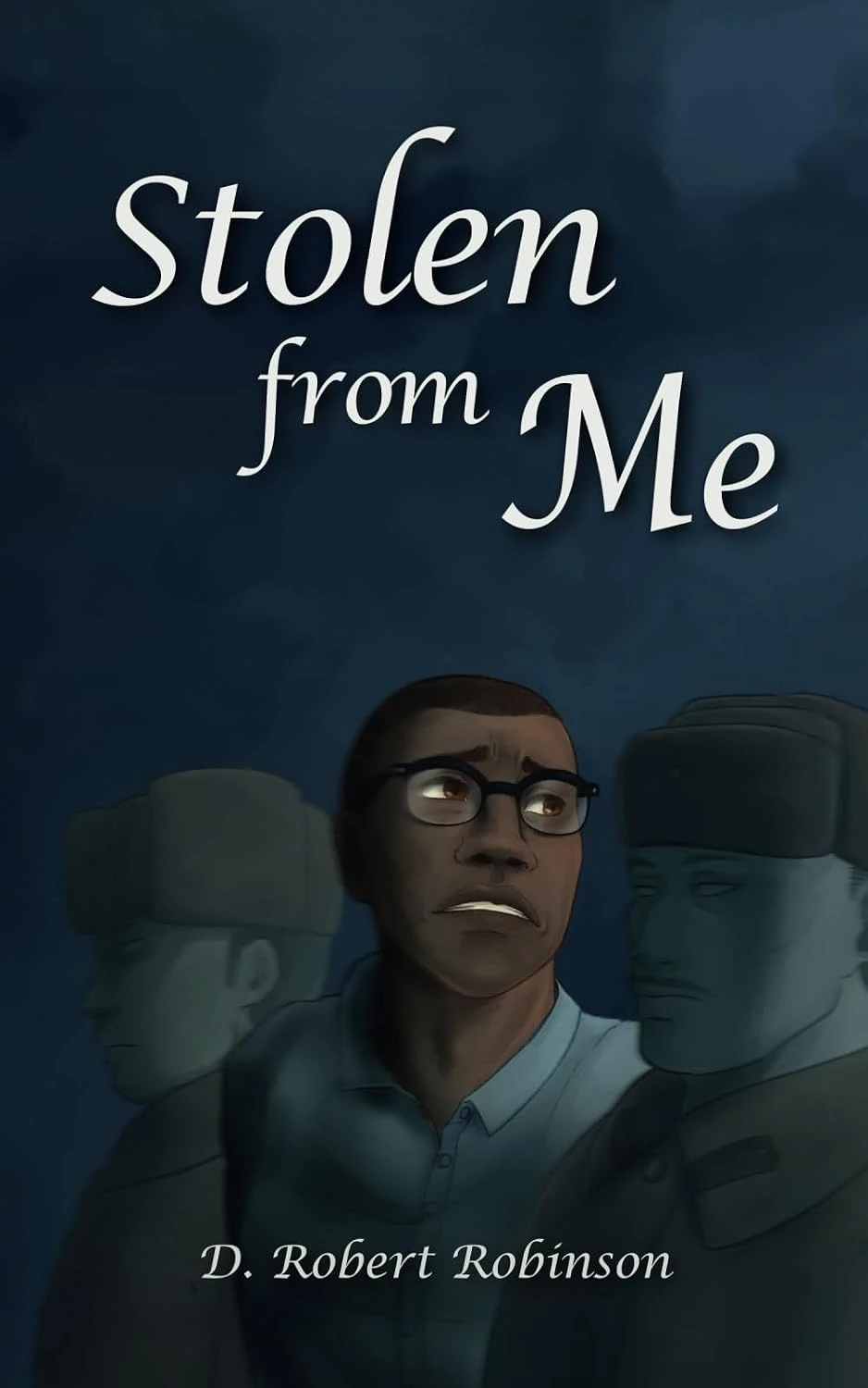
Stolen from Me
Quick Take
An ambitious Cold War-era historical drama about a brilliant Black American scientist whose extraordinary mind becomes both his greatest gift and the instrument through which decades of his life are taken.
Short Review
D. Robert Robinson’s Stolen from Me is an ambitious historical drama that combines romance, science, Cold War politics, racial identity, and decades of forced separation into the story of Benjamin Hughes, a gifted Black American scientist whose breakthrough in electrical transmission makes him valuable to people far beyond his university laboratory.
The novel begins quietly, establishing Benjamin’s love for Nadejda and his promising scientific work before a trip connected to her family history changes everything. Benjamin is separated from the woman he loves and effectively detained, leaving him with a brutal choice: allow his life and talent to disappear into captivity or cooperate with the people controlling him in hopes of someday returning home.
Robinson builds tension less through conventional action than through surveillance, political pressure, scientific ambition, isolation, racial prejudice, and the slow realization that Benjamin’s brilliance has become both his greatest power and his prison. His absence also has profound consequences for Nadejda, who must face pregnancy and motherhood without knowing when—or whether—Benjamin will return.
The novel’s greatest strength is its scope and moral question: who owns extraordinary human talent—the individual, the nation, or whoever possesses the power to exploit it? Its deliberate pacing and extended scientific and political discussions will be demanding for readers seeking a rapid thriller, but those drawn to expansive historical fiction will find a thoughtful story about freedom, love, race, purpose, and perseverance.
Full Review
D. Robert Robinson’s Stolen from Me begins as a tender historical romance and gradually expands into something much larger: a decades-spanning political and scientific drama about a gifted Black American whose intelligence becomes so valuable that powerful institutions begin treating his life as something they have the right to possess.
Benjamin Hughes is a young researcher in the 1960s whose work in electrical transmission has the potential to reshape infrastructure on a massive scale. Yet Robinson initially introduces Benjamin not through geopolitics, but through love. Benjamin’s relationship with Nadejda is affectionate, earnest, and central to his emotional life. Their differences in background and temperament matter, but the relationship is presented as something stabilizing rather than destructive. Benjamin is cautious and intellectually driven; Nadejda is more adventurous, emotionally expressive, and willing to pull him beyond familiar boundaries.
That willingness eventually leads them toward Nadejda’s ancestral homeland. What begins as a romantic journey becomes the hinge on which Benjamin’s entire life turns. His emerging scientific breakthrough has already attracted attention beyond the university, and seemingly ordinary conversations occurring around him reveal forces operating well outside his knowledge.
The novel’s real dramatic engine arrives when Benjamin is separated from Nadejda and effectively detained because of his scientific expertise. Suddenly the young man who believed knowledge could improve life discovers another reality: knowledge also creates power, and power attracts people willing to control its source. Benjamin is placed in a deeply unsettling position. He can resist and potentially disappear into political obscurity, or use the one resource still entirely his—his mind—in the hope that cooperation will eventually lead him home.
From there, Stolen from Me develops into a historical-political saga rather than a conventional thriller. Benjamin becomes increasingly involved in the modernization of Soviet electrical infrastructure, working among scientists who are themselves caught between intellectual ambition, political expectations, espionage, national pride, and competing interests. The stakes are not framed primarily through gunfights or action sequences. Robinson instead builds tension through confinement, surveillance, manipulation, bureaucracy, secrecy, institutional dependency, and the disturbing realization that Benjamin’s usefulness may be the very thing preventing his freedom.
Race adds another significant layer. Benjamin’s brilliance can make him indispensable without making racial prejudice disappear. He remains a Black American operating inside institutions that sometimes admire his intellect while simultaneously reducing him to his race or viewing his identity as a political liability. In one especially revealing exchange, an official openly identifies Benjamin’s race as a problem even while acknowledging that the country needs what Benjamin can provide. The contradiction is one of the novel’s strongest ideas: institutions can depend upon a Black man’s talent while remaining uncomfortable with the Black man himself.
Robinson also refuses to let the political story erase the emotional one. Nadejda’s life continues while Benjamin is absent, and the consequences of his disappearance extend beyond him. Her pregnancy and the birth of their daughter deepen the cost of his captivity, giving the title a broader meaning. Benjamin has not merely had years stolen from him; relationships, parenthood, identity, and ordinary experiences have been taken as well.
Structurally, the novel spans decades and is framed by an older Benjamin recounting his life. This gives the narrative the quality of remembered history rather than immediate-action suspense. Robinson spends considerable time on scientific discussions, political negotiations, correspondence, relationships, and Benjamin’s interior reflections. Readers who enjoy expansive historical narratives may appreciate that deliberate accumulation. Those looking for a fast Cold War thriller may find portions slow, particularly when scientific and governmental conversations extend across several scenes.
The prose is most effective when Benjamin’s intellectual curiosity collides with emotional vulnerability. Letters from home become enormously important because small signs of connection carry immense meaning to a man whose freedom has been restricted. Robinson understands that a character does not need to be physically brutalized for captivity to become psychologically punishing.
There are also moments when the novel’s scope works against its momentum. At roughly four hundred pages, the story frequently pauses to examine meetings, technical concepts, political calculations, travel, and interpersonal exchanges in detail. The measured pace serves the sense of decades passing, but some readers will feel the narrative could reach its strongest emotional and political moments more quickly.
Still, Stolen from Me ultimately earns much of its scale because Benjamin’s story is not simply about escape. It asks what happens when an individual’s talent becomes national property, whether intellectual achievement can justify personal sacrifice, and how a person preserves identity when governments, institutions, lovers, colleagues, and history itself keep assigning him roles.
Robinson closes on an ultimately hopeful note, emphasizing family, endurance, intellectual contribution, and the belief that science should transcend race and nationality. For readers interested in Black historical fiction, Cold War intrigue, science-driven political drama, and long-form stories about resilience, Stolen from Me offers an unusual and ambitious journey.
Pull Quotes
Content Notes
Language: Moderate; occasional strong profanity, including repeated use of “fuck,” along with dated racial terminology such as “Negro.”
Violence: Mild to moderate; threats, coercion, political captivity, danger, and references to unrest and conflict are present, but graphic physical violence is not a dominant feature.
Sexual Content: On-page but non-graphic; kissing, romantic intimacy, implied sexual relationships, and scenes progressing to removal of clothing without explicit sexual description.
Drugs/Alcohol: Mild to moderate social alcohol use, including wine; no significant drug-use theme evident in the manuscript.
Sensitive Topics: Kidnapping, prolonged involuntary confinement, surveillance, political coercion, racism, interracial prejudice, pregnancy during forced separation, abandonment fears, isolation, depression, betrayal, espionage, and loss of personal freedom.