
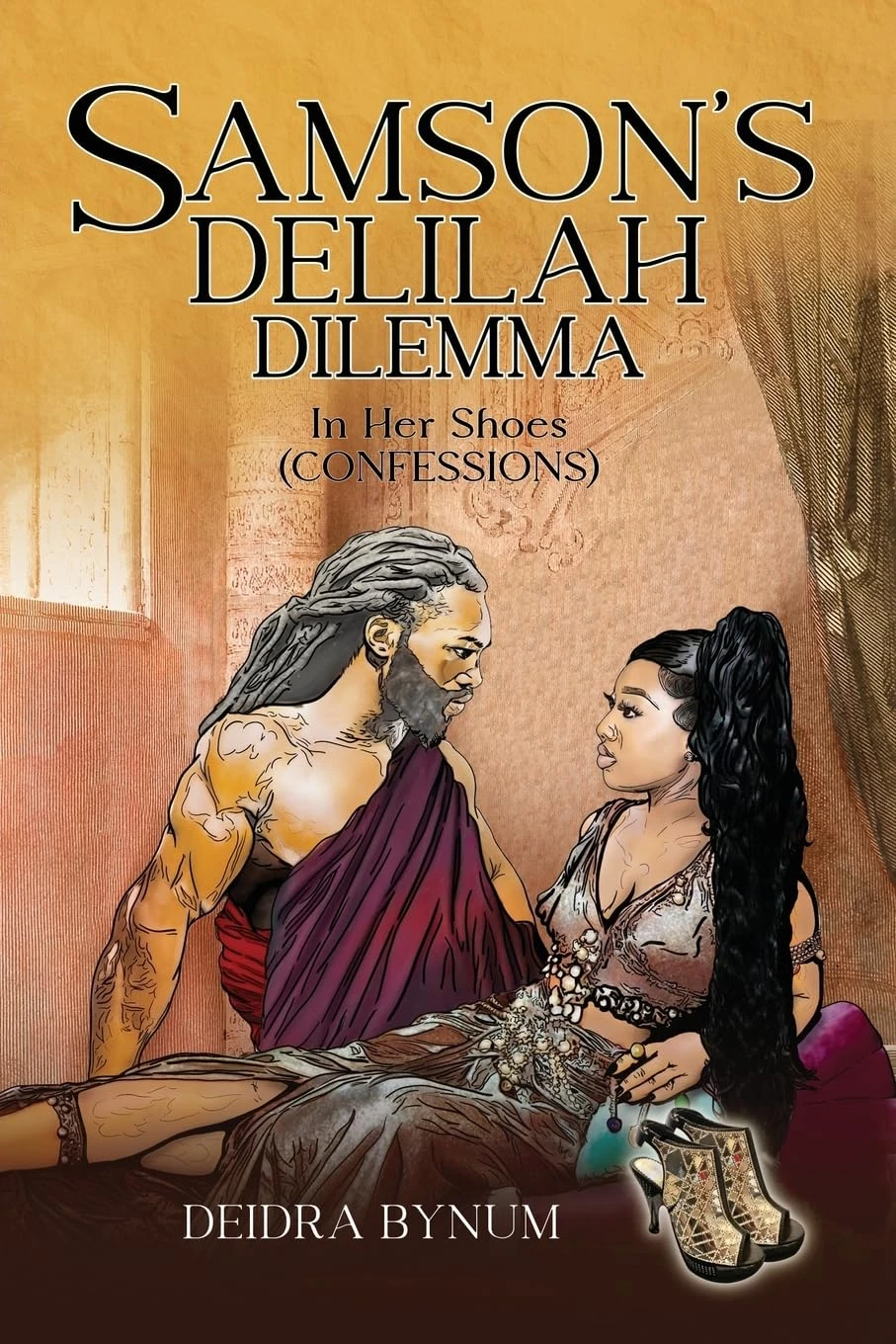
Samson’s Delilah Dilemma
Ready to Read It?
Use the button or the permanent True Voice Review purchase link.
TrueVoiceReview.com/b/samsonsdelil Scan to Buy the Book
Quick Take
Ancient spiritual lessons find unexpectedly modern homes in relationships, businesses, barbershops, and everyday choices. Beneath the humor and heightened drama lies a serious message: failure does not necessarily cancel purpose.
Short Review
Deidra Bynum’s Samson’s Delilah Dilemma: In Her Shoes (Confessions) is an ambitious blend of Christian fiction, biblical interpretation, testimony, humor, and contemporary cautionary storytelling built around one central question: how can strong, intelligent, gifted people become vulnerable to their own desires and choices?
The book begins by creatively recasting Samson as a talented young basketball player whose confidence and attraction to a modern Delilah lead him past the warnings of his mother and coach and into devastating consequences. It then revisits the biblical Samson before expanding into “In Her Shoes,” a collection of stories in which contemporary women encounter their own forms of temptation, deception, ambition, romantic trouble, and eventual spiritual reckoning.
Bynum writes with an exuberant, highly recognizable voice. Wordplay, humor, emphatic capitalization, biblical parallels, scripture, and direct spiritual teaching are woven throughout. The approach can be entertaining and surprisingly inventive, particularly when familiar biblical ideas are transplanted into barbershops, businesses, relationships, and even the adventures of an incorrigible alley cat.
The same abundance may challenge some readers. The book is lengthy, strongly sermon-oriented, and often pauses its narratives for scriptural interpretation or extended commentary. Readers seeking understated or secular fiction should look elsewhere.
For its intended audience, however, the book has clear appeal. Christian readers who enjoy testimony-centered stories and modern applications of biblical teaching will find an energetic examination of pride, temptation, discernment, repentance, grace, and the possibility of beginning again.
Full Review
Samson’s Delilah Dilemma: In Her Shoes (Confessions) by Deidra Bynum is an unconventional work of Christian inspirational storytelling that blends biblical retelling, contemporary fiction, testimony, humor, cautionary tales, and personal reflection into one expansive volume. Rather than simply recounting the familiar story of Samson and Delilah, Bynum uses Samson’s weaknesses, choices, consequences, and eventual redemption as a recurring framework for examining temptation, relationships, pride, deception, faith, identity, and the importance of listening to spiritual and parental wisdom.
The book opens with “Momma Said,” a modernized reimagining that transforms Samson into a gifted young basketball player whose strength, confidence, romantic impulsiveness, and attraction to a dangerous young woman parallel the biblical figure. The contemporary setting makes the underlying lesson immediately accessible: talent and strength do not protect someone from poor judgment. After Samson ignores repeated warnings from his mother and coach, a flirtation with Delilah leads him into circumstances involving alcohol, betrayal, a brutal assault, and serious damage to his eyesight. His recovery ultimately becomes as much spiritual as physical.
That story establishes the book’s central pattern. Biblical Samson becomes less a distant Old Testament personality than an archetype: someone extraordinarily gifted who can nevertheless become vulnerable through desire, pride, misplaced trust, and the refusal to recognize warning signs. Bynum then returns directly to Judges 13–16, with Momma Flora narrating and interpreting Samson’s biblical story. Scripture is not background decoration here; it is the foundation of the book’s worldview and frequently becomes part of the narrative itself.
The second half, “In Her Shoes (Confessions),” broadens the concept through a series of contemporary stories centered largely on women confronting their own versions of temptation, insecurity, manipulation, ambition, romantic confusion, betrayal, or self-deception. Stories such as “Barber, Barbara,” “Samson the Alley Cat,” “Silent Partners,” and “Beauty Has A Brain” vary widely in tone and circumstance, sometimes moving from comedy into drama within only a few pages. A female barber’s encounter with a striking father and son, a troublesome tomcat whose escapades echo the biblical Samson, business relationships complicated by attraction and betrayal, and a woman forced to confront the consequences of using beauty and manipulation all serve the same larger purpose: placing ancient spiritual lessons into recognizable modern situations.Bynum’s strongest asset is her unmistakable voice. The writing is energetic, conversational, theatrical, and filled with wordplay, nicknames, capitalization, repeated phrases, biblical parallels, and deliberate verbal twists. There is little danger of mistaking this for restrained literary fiction. The stories often sound as though they are being told aloud by an animated storyteller who expects the audience to laugh, react, recognize the lesson, and eventually hear the sermon inside the story.
That exuberance is also where some readers may struggle. At more than 250 pages, the volume is structurally dense, and its frequent scriptural quotations, commentary, repeated motifs, extended explanations, and shifts between fiction, biblical interpretation, testimony, and devotional teaching can make individual sections feel longer than their underlying narratives require. Readers expecting a conventional novel or a tightly plotted anthology may find the format sprawling. The heavy use of emphatic capitalization and elaborate wordplay will also be an acquired taste.
The book is equally unapologetic about its Christian perspective. Salvation through Jesus Christ, obedience to God, repentance, divine purpose, spiritual warfare, and biblical authority are treated as truths rather than themes to be debated. That clarity sharply defines the audience. Readers seeking secular relationship fiction will likely feel outside the conversation; Christian readers who enjoy testimony-driven storytelling, contemporary biblical parallels, and spiritually explicit moral narratives are much more likely to connect with it.
Beneath the heightened humor and dramatic scenarios is a serious idea: strength is not the absence of vulnerability. Samson can defeat enemies and still be conquered by his own appetites. Intelligent women can make foolish decisions. Attractive people can be deceived by appearances. Success can become its own trap. And failure, in Bynum’s spiritual framework, does not necessarily cancel purpose. Redemption remains possible after humiliation, betrayal, loss, or self-inflicted disaster.
The result is a highly individual book—part biblical commentary, part contemporary cautionary fiction, part women’s inspirational anthology, and part personal testimony. Its unconventional structure will not suit every reader, but its convictions are clear and its personality is impossible to miss. For readers comfortable with overt Christian teaching and looking for stories that connect scripture with contemporary relationships and everyday choices, Samson’s Delilah Dilemma offers an energetic and often imaginative exploration of temptation, consequences, grace, and second chances.
Pull Quotes
Content Notes
Language: Mild; little to no strong profanity. Biblical and religious language is frequent.
Violence: Moderate. Includes assault, beatings, temporary/permanent visual impairment, biblical killings and deaths, beheading references, and animal injury/death; generally described without prolonged graphic detail. - Sexual Content: Suggestive and implied sexual situations, seduction, adultery/affairs, romantic manipulation, and references to sexual relationships; not primarily explicit or graphically described.
Drugs/Alcohol: Alcohol consumption and intoxication appear in several situations, sometimes contributing to poor judgment or dangerous circumstances.
Sensitive Topics: Betrayal, manipulation, abusive behavior, assault, disability/blindness, grief, discrimination, infidelity, spiritual warfare, death, trauma, and repentance.