
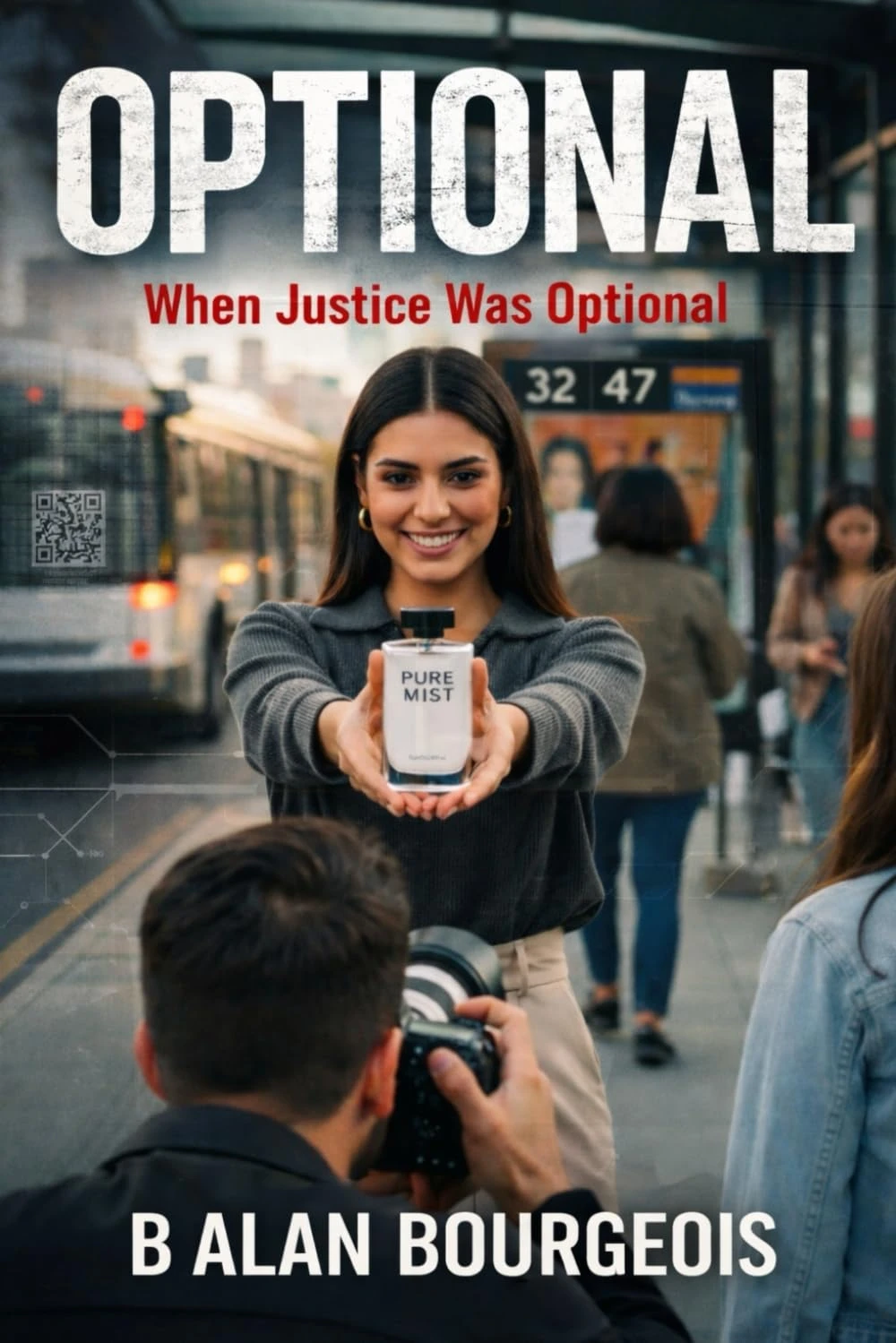
Optional
Quick Take
A fast, unsettling modern thriller where a “totally optional” fragrance sample at transit stops becomes the spark for mass harm—exposing how attention, consent, and performance can be engineered into a weapon.
Short Review
Optional is a contemporary thriller that turns a familiar modern nuisance—street “sampling” and influencer hustle—into a national-scale crisis. When hospitals begin reporting clusters of respiratory distress, confusion, and seizures, a repeating detail emerges: multiple patients mention being “sprayed” with a fragrance sample at transit stops. The story’s early tension comes from how it mirrors real response work—uncertain data, cautious language, and the pressure to act without igniting panic.
A major thread follows Mara, a Dallas influencer hired to run the campaign, who believes she’s doing a legitimate promo built on the comforting language of consent: “totally optional.” As the fallout spreads, the book examines how attention economies train people to treat strangers as content—and how “permission” can be engineered through tone, optics, and social pressure. Other perspectives widen the lens to show institutional triage, public rumor cascades, and families forced to watch grief become entertainment.
The prose is lean and propulsive, and the structure—multiple viewpoints across cities and roles—builds a layered picture of complicity and consequence without relying on gore or spectacle. The result is tense, timely, and morally sharp. Readers who enjoy modern civic thrillers, procedural momentum, and stories about manipulation in the age of virality will find Optional gripping. Readers looking for light escapism or neat catharsis may find it uncomfortably realistic.
Full Review
Optional opens with a detail that feels almost laughably small—people reporting they were “sprayed” on the wrist with a fragrance sample at transit stops—until emergency rooms begin filling with respiratory distress, confusion, and seizures, and a pattern snaps into place across multiple metros. The early chapters move with the calm, clinical focus of public-health and emergency-management work: cautious questions, thin data, repeating anecdotes, and the constant discipline of not saying the scariest word too soon. It’s an unsettling hook because the exposure is mundane, public, and plausible—exactly the kind of “harmless” contact modern life trains people to ignore.
From there, the book widens into a braided, contemporary thriller about attention as infrastructure and consent as performance. A key strand follows Mara, a Dallas influencer hired to run a street “sampling” campaign designed to look clean, safe, and optional—an aesthetic of legitimacy that becomes part of the harm. Her arc isn’t built around cartoon villainy; it’s built around the ordinary hunger of a platform economy: engagement metrics, brand polish, and the learned reflex to turn strangers into content. The story is at its sharpest when it shows how easily “permission” can be engineered, how quickly a smile becomes a sales tactic, and how “optional” can be weaponized as moral cover.
Counterbalancing the influencer vantage is the response side: the professionals trying to keep systems steady while the country’s nervous system misfires in real time. The procedural passages aren’t filler; they’re thematic reinforcement. The book understands that crisis isn’t just an event—it’s an information environment: rumors racing ahead of verification, commentary hardening into belief, and institutions forced to act while still building the map. That tension—between speed and certainty—creates suspense without relying on gimmicks.
The prose is lean, modern, and rhythmically controlled, with clean scene-to-scene momentum and a strong ear for the language of the moment (feeds, stitches, trends, virality) without drowning in jargon. Structurally, Optional uses shifting perspectives to turn a single act into a national prism. The effect is cumulative: every viewpoint adds moral weight—victims become more than headlines, and complicity becomes less abstract. The emotional center sharpens when grief enters the frame not as melodrama but as testimony: family members naming the dead and refusing the internet’s hunger for entertainment, even in tragedy.
Themes land with force: manipulation, social engineering, the monetization of proximity, and how quickly a public can be “steered” when fear and outrage become content. The novel’s political edge is present but not preachy; it’s embedded in systems and incentives rather than speeches. Its most chilling insight is that modern harm doesn’t need a monster costume—it needs logistics, plausible paperwork, and people trained to trust presentation over substance.
Some readers may find the book’s realism heavy. It spends time in institutional rooms and digital feedback loops, and it refuses to offer easy catharsis or tidy moral accounting. The emotional aftershocks—guilt, public pile-on, and irreversible consequence—are part of the point, but that can feel bleak to readers seeking a cleaner “good guys win” arc. Still, for readers drawn to ripped-from-the-feed thrillers—stories where the villain is a machine made of incentives—Optional is bracingly effective: fast, topical, and disturbingly believable.
Pull Quotes
Content Notes
• Language: Mild.
• Violence: Moderate (mass casualty event; suicide by gunshot; medical emergencies).
• Sexual Content: None.
• Drugs/Alcohol: None noted.
• Sensitive Topics: Public panic, grief, death, exploitation/complicity, suicide.