
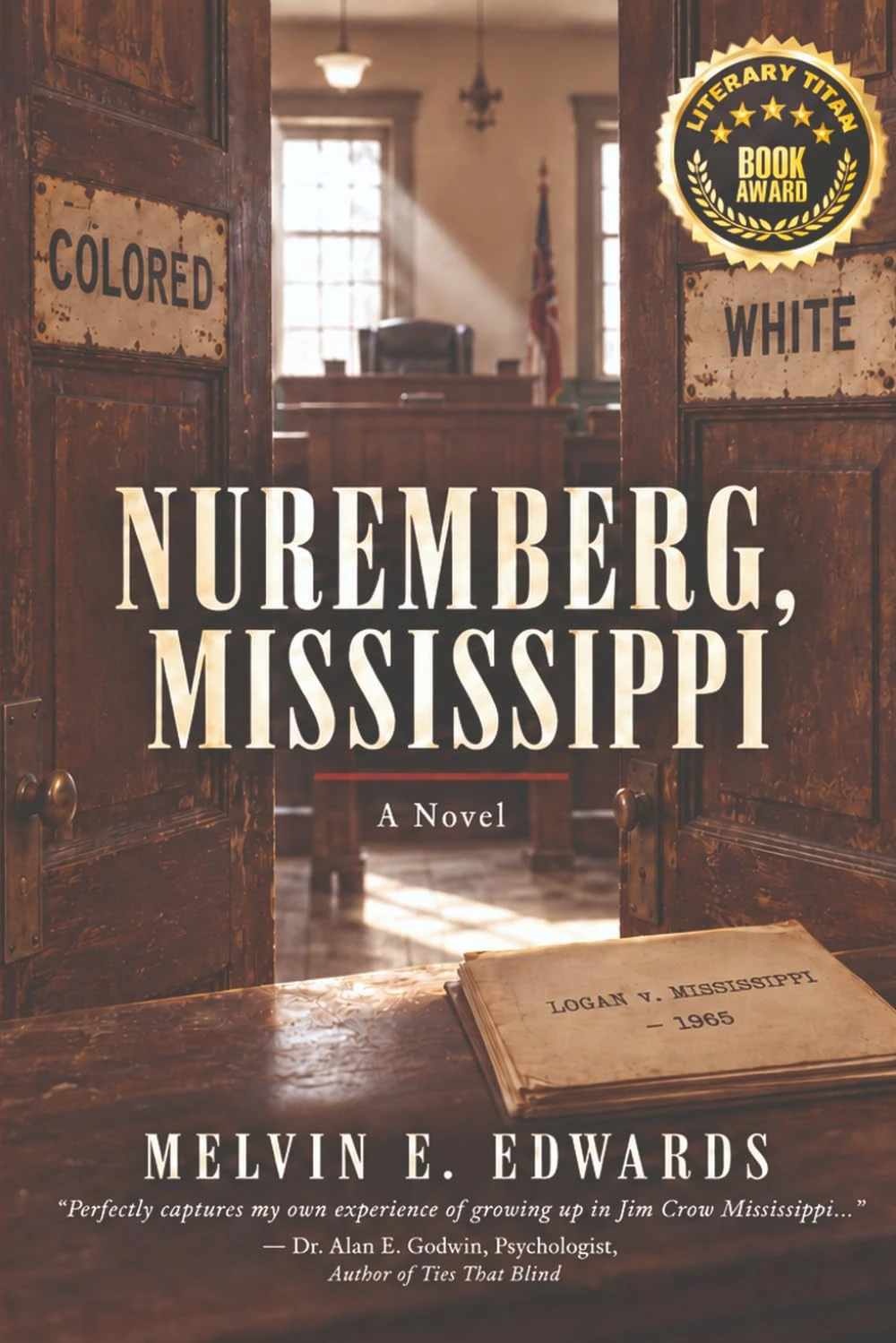
Nuremberg, Mississippi
Ready to Read It?
Use the button or the permanent True Voice Review purchase link.
TrueVoiceReview.com/b/nuremberg Scan to Buy the Book
Quick Take
This is not a story of one verdict changing the world, but of courageous people forcing the world to preserve a record of what it refused to change.
Short Review
Set in 1960s Mississippi, Nuremberg, Mississippi follows Henry Logan, a Black laborer whose freedom, employment, and family security are constrained by the unwritten rules of a sundown town. After Henry is arrested for remaining in town after dark, white attorney Silas Thorn III helps reduce his sentence but initially fails to question the system that imposed it.
When administrative retaliation continues after Henry’s release, Henry asks Silas to bring a federal case against Mississippi. Their legal fight exposes a structure in which no single official accepts responsibility because each discriminatory act can be defended as procedure, discretion, or local custom.
Melvin E. Edwards writes in brief, tightly focused chapters that mirror the incremental nature of institutional harm. The novel is strongest in its domestic and procedural details: Helen Logan rationing food after work disappears, clerks hiding behind neutral language, and Silas slowly discovering that moderation can protect injustice more effectively than open hostility.
The dialogue can become highly polished and philosophical, with characters sometimes speaking more like voices in a moral debate than ordinary people. Readers seeking fast courtroom suspense or a conventionally victorious ending may also find the novel’s measured, unresolved approach challenging.
For readers of historical legal fiction and civil-rights literature, however, Nuremberg, Mississippi offers a forceful examination of how racism survives through routine professional behavior. It is a sobering novel about legality without justice, recognition without remedy, and the human cost of asking oppressed people to remain patient.
Full Review
Nuremberg, Mississippi is a historically grounded legal drama about the difference between injustice that breaks the law and injustice that learns to operate comfortably within it. Set primarily in 1960s Mississippi, Melvin E. Edwards’s novel follows Henry Logan, a Black husband, father, and skilled laborer whose life is controlled by the unwritten restrictions of a sundown town, and Silas Thorn III, a white attorney raised to regard restraint, stability, and procedural order as moral virtues.
The story begins with ordinary acts made dangerous by racial control. Black workers calculate how much daylight remains. A man waiting for a bus is sentenced for refusing to move when ordered. Henry is arrested after remaining in town past sunset, even though he was completing work at Silas’s home. Silas represents him and succeeds in reducing a ninety-day sentence to thirty days. To Silas, the reduction initially demonstrates that the system can correct itself. To Henry, it demonstrates that an unjust punishment has merely been made more manageable.
That distinction becomes the novel’s central moral conflict.
After Henry’s release, the consequences continue through delayed permits, lost work, administrative reviews, police observation, and other actions that are individually defensible but collectively devastating. Henry eventually asks Silas to represent him in a federal case against Mississippi. He does not expect the lawsuit to restore everything he has lost. He wants the machinery placed on the record so that the state can no longer claim that no machinery exists.
Henry is the novel’s moral center, but he is not written as a symbolic saint. He is intelligent, controlled, proud, exhausted, and painfully aware that every public choice may endanger his wife, Helen, and their children. His restraint is not passivity. It is a survival skill developed in a world where Black anger is treated as proof of guilt. Helen is equally important, offering a practical understanding of danger that Silas repeatedly fails to grasp. The novel is especially effective when it shows the Logan family managing fear through household routines, careful travel, rationed food, guarded conversations, and the constant measurement of risk.
Silas undergoes the book’s largest transformation. At first, he believes professionalism means working patiently within accepted limits. He is not presented as an obvious racial fanatic. That is precisely the point. He benefits from the system, explains it, moderates its worst appearances, and initially mistakes small concessions for justice. His growing friendship with Henry forces him to recognize that neutrality is often merely complicity expressed in a respectable tone.
Edwards structures the novel in short chapters, some only a few pages long. The fragmented form gives the book momentum while also reflecting how institutional oppression accumulates: one form, one delay, one ruling, one warning, one lost opportunity at a time. The prose is controlled, frequently aphoristic, and strongest when concrete details carry the argument. A courthouse entrance, a permit file, an empty chair at a church supper, or a copy of The Negro Motorist Green Book can communicate more than a speech.
At times, however, the novel’s philosophical language becomes repetitive. Characters regularly speak in polished declarations about law, order, abstraction, visibility, and responsibility. Many of these lines are memorable, but the accumulation can make conversations feel designed to present the book’s thesis rather than arising spontaneously between individuals. Some readers may also find that secondary characters function more as representatives of institutions or moral positions than as fully developed people.
The courtroom material avoids conventional thriller theatrics. The central case develops through legal filings, evidentiary barriers, strategic compromises, and the careful language institutions use when recognizing harm without accepting responsibility. Readers expecting a triumphant civil-rights verdict may find the story deliberately frustrating. This is not a narrative in which one courageous lawsuit sweeps away a corrupt system. It is about what happens when a court acknowledges suffering and still concludes that no remedy is available.
The title’s comparison between Jim Crow Mississippi and Nuremberg is provocative, but the novel does not argue that the two histories are identical. Instead, it examines the shared moral defense that lawful authority, professional duty, tradition, or obedience can excuse participation in systematic harm. The result is a serious and unsettling novel about institutional endurance, racial injustice, moral awakening, and the limits of legal victory.
Nuremberg, Mississippi will work best for readers who appreciate historically informed literary fiction, courtroom narratives, and morally demanding stories that value examination over consolation. Its strongest achievement is making bureaucracy feel personal. The novel shows that injustice does not always arrive shouting. Sometimes it enters quietly, follows procedure, obtains the necessary signatures, and closes the file.
Pull Quotes
Content Notes
Language: Mild overall; includes period-appropriate racial terminology, including repeated use of “Negro,” and limited mild profanity.
Violence: Moderate thematic violence; racial intimidation, threats, references to lynching and a hanging tree, health crises, and a fatal automobile collision. Descriptions are generally restrained rather than graphic.
Sexual Content: None.
Drugs/Alcohol: Mild alcohol references, including public drunkenness and social drinking.
Sensitive Topics: Jim Crow segregation, systemic racism, racial harassment, sundown-town restrictions, economic retaliation, police intimidation, generational trauma, illness, death, grief, and historical racial terror.