
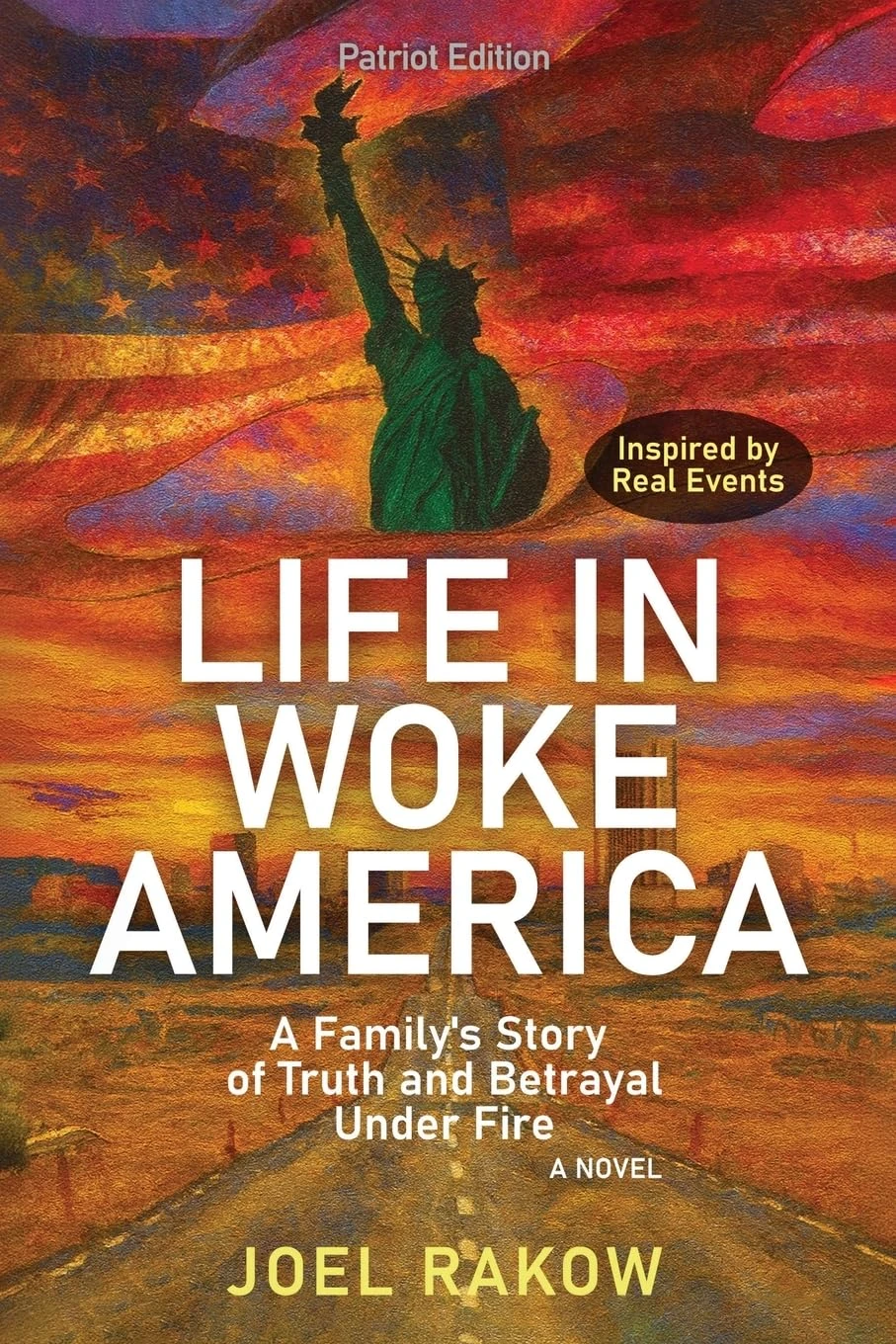
Life in Woke America
Ready to Read It?
Use the button or the permanent True Voice Review purchase link.
TrueVoiceReview.com/b/lifewoke Scan to Buy the Book
Quick Take
Beneath its fiercely political surface, Life in Woke America is an unexpectedly tender story about a former foster child determined to build the family, purpose, and permanence he never received.
Short Review
Life in Woke America blends political thriller, romance, family drama, and autofiction in the story of Xavier King, a former foster child and Army veteran whose involvement in uncovering an alleged Chinese biological-weapons operation brings him before Congress and into conflict with institutions he believes are determined to silence him.
Yet Xavier's deeper mission is intensely personal: he wants to create the stable, affectionate family his childhood denied him. His relationship with Audrey becomes the novel's emotional anchor, while the arrival of the seriously ill Adina and her young son complicates their emerging family in ways involving attraction, fertility, sacrifice, loyalty, and unconventional parenthood. The book handles these relationships with considerable emotional openness and frequent sexual candor.
The novel's strongest feature is Xavier's distinctive, highly self-aware voice. Its greatest limitation is the same voice's tendency to explain nearly everything. Political commentary, institutional criticism, historical discussion, technology, business philosophy, and relationship analysis can overwhelm momentum, and readers seeking ideological ambiguity will find the book firmly committed to Xavier's worldview.
Still, beneath its provocative title and combative politics is a surprisingly hopeful story about rebuilding. Xavier ultimately attempts to transform the institutional failures of his childhood into something constructive for another generation.
This is a novel for readers comfortable with strong political opinions, unconventional family arrangements, mature sexuality, and a protagonist determined to challenge nearly every institution that tries to define him.
Full Review
Life in Woke America is an ambitious, politically charged work of autofiction that combines domestic drama, romance, political thriller, military intrigue, and social commentary into the story of Xavier King, a former foster child and Army veteran determined to build the stable family life he never had. The manuscript explicitly identifies itself as autofiction, blending personal experience, documented public events, observation, and invention while presenting its political and social critiques as satirical opinion.
The novel opens with Xavier preparing to testify before Congress about his role in discovering what he believes to be a secret Chinese biological-weapons operation. His investigation has already brought severe consequences: accusations of extremism, placement on a no-fly watchlist, political hostility, and the realization that institutional power can punish a person even when he believes he has acted honorably. Yet the political conflict is only one half of Xavier's story. The other—and frequently the more emotionally compelling half—is his determination to become the husband and father he never had.
Raised amid foster care, parental addiction, instability, and the lingering trauma of his family's destruction, Xavier treats adulthood as something he must deliberately construct. His longing for a home filled with affection, children, ritual, loyalty, and permanence gives the sprawling novel its strongest emotional through-line. The manuscript repeatedly returns to the contrast between institutional life and intimate family life: the former governed by bureaucracy and suspicion, the latter by chosen responsibility and tenderness. Xavier's history includes cartel violence against members of his family, his mother's escalating addiction and eventual death, and his own childhood displacement.
Audrey becomes the center of the life Xavier wants to build. Their relationship is unusually verbal and analytical: they discuss attraction, boundaries, fidelity, family, sex, parenting, career, and emotional needs in exhaustive detail. For readers who enjoy characters examining the mechanics of a relationship instead of merely falling into one, their courtship has considerable appeal. It is sensual as well as romantic, with sexuality treated openly and sometimes humorously; the book discusses intercourse, orgasm, fertility, contraception, and sexual attraction without generally becoming graphically anatomical.
The arrival of Adina complicates that domestic vision in unexpected ways. Her declining health, her son Matto, her growing bond with Audrey, and Xavier's attraction to her create an unconventional family problem that the novel approaches primarily through loyalty, consent, sacrifice, parenthood, and mortality rather than conventional romantic rivalry. The resulting arrangements will be challenging for some readers, but they also lead to some of the manuscript's most emotionally serious material. Adina's desire to secure a future for Matto—and eventually to create another child for the family despite the risks of her illness—turns sexuality into an extension of the book's persistent question: what does one person owe another when love, duty, mortality, and personal freedom collide?
Stylistically, the novel is dominated by Xavier's highly self-aware first-person voice. He is observant, confident, argumentative, sentimental, occasionally comic, and rarely uncertain for long. This gives the book personality, but it also contributes to its principal limitation: Life in Woke America is often more interested in explaining its worldview than allowing readers to infer it. Political arguments about government bureaucracy, COVID policy, China, race, media, tribal governance, immigration, affirmative action, AI, censorship, and institutional power recur throughout the narrative. By the final chapters, Xavier's political philosophy is no subtext; it is one of the book's central subjects. The later narrative explicitly contrasts mainstream media with social-media-driven “infowar” and presents Xavier's information campaign as a means of defeating institutional suppression.
That ideological directness will sharply divide the audience. Readers sympathetic to Xavier's skepticism of government, mainstream media, identity politics, and progressive institutions may find the novel unusually validating. Readers seeking political ambiguity, competing viewpoints of comparable strength, or characters whose ideological positions remain unresolved may find sections polemical. The same issue affects pacing: lengthy discussions of technology, government, business practices, history, politics, and relationship philosophy periodically slow what might otherwise function as a tauter political thriller.
The book nevertheless has an unexpectedly hopeful core. Its final movement is less about defeating enemies than about Xavier transforming damage into generational purpose. A former bioweapon site becomes a home for boys aging out of foster care, directly connecting his traumatic childhood with the kind of institution he wishes had existed for him. That transformation is the novel's strongest answer to its own anger: institutions may fail, but people can still build better ones.
Life in Woke America is therefore best approached not as a conventional thriller but as an expansive ideological family saga with thriller elements. It is provocative, intensely earnest, sexually candid, politically unapologetic, and deeply invested in the idea that personal competence, family loyalty, truth-seeking, and individual agency can rescue people from systems that have failed them.
Pull Quotes
Content Notes
Language: Mild to moderate; occasional profanity and coarse sexual expressions, but sustained strong profanity is not prominent.
Violence: Moderate; biological-warfare threats, cartel murders, historical massacres, military/security danger, weapons, threats, and descriptions of death, though most violence is not graphically depicted. Xavier recounts cartel killings of several relatives, including a grandfather burned in a truck.
Sexual Content: Mature and on-page but generally non-graphic; nudity, intercourse, orgasms, fertility, contraception, sexual arousal, foreplay, and repeated discussion of reproduction.
Drugs/Alcohol: Moderate thematic presence; parental drug and alcohol addiction is important to Xavier's childhood, including his mother's deterioration and death.
Sensitive Topics: Foster care, childhood neglect, addiction, parental death, cartel violence, terminal illness, grief, institutional abuse, discrimination, political extremism accusations, biological warfare, infertility/fertility concerns, death during/after high-risk pregnancy, racial and ethnic identity, and contentious political and cultural issues.