
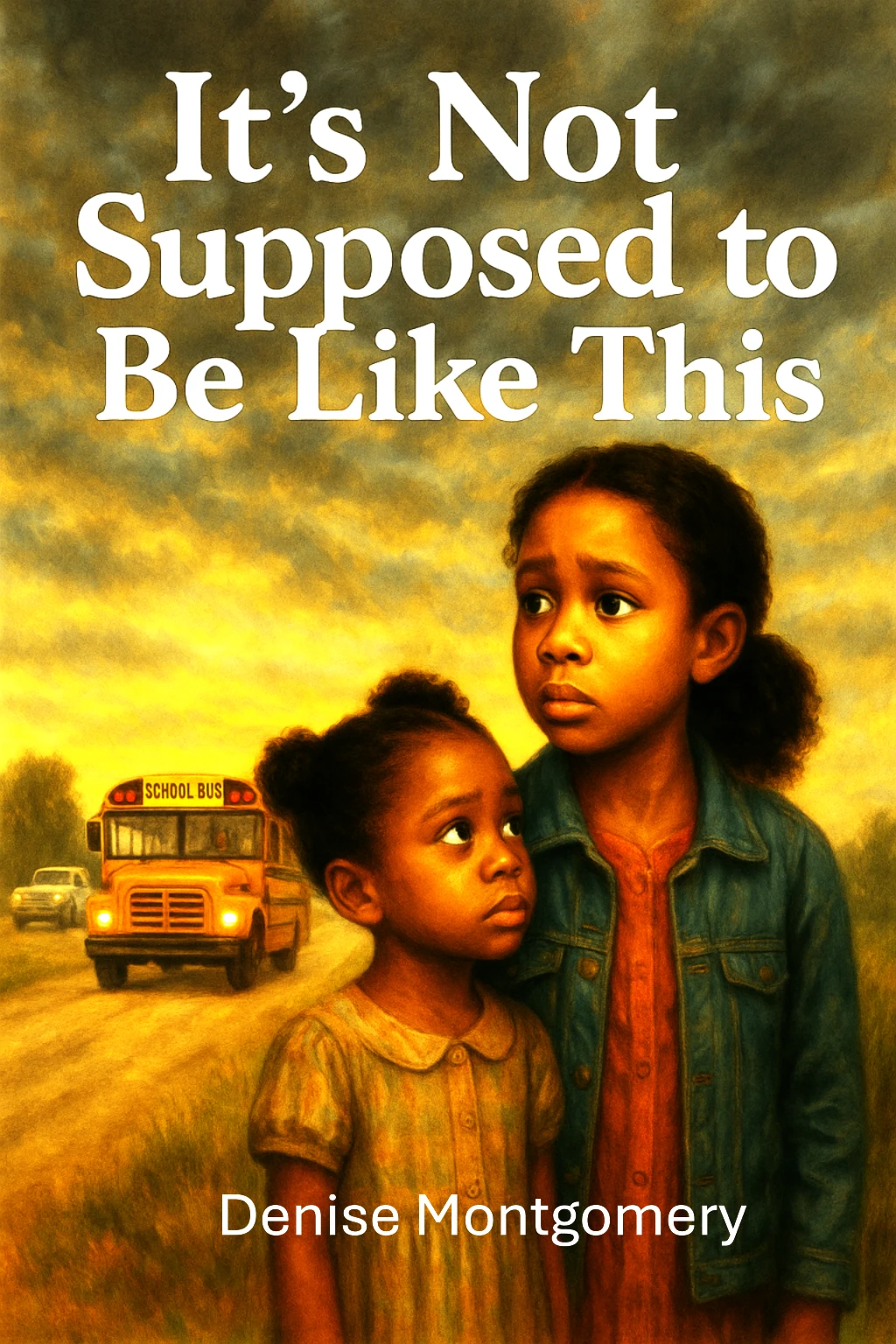
It's Not Supposed to be Like This
Ready to Read It?
Use the button or the permanent True Voice Review purchase link.
TrueVoiceReview.com/b/itsnotsuppos Scan to Buy the Book
Quick Take
A warm, emotionally charged historical novel, It’s Not Supposed to Be Like This pairs civil-rights-era racism with domestic abuse and Christian hospitality, tracing one Black girl’s journey from wounded anger to risky, hard-won compassion.
Short Review
It’s Not Supposed to Be Like This follows eleven-year-old Rene in 1960s East Texas after a humiliating, racist incident at the State Fair of Texas shatters her sense of safety. When a white mother and her two children, fleeing domestic violence and their father’s racism, show up at Rene’s Black church and later enroll in her segregated school, Rene must decide whether to shut them out or live out the Christian hospitality her community preaches. The novel’s biggest strengths lie in Rene’s honest, wounded voice; the vibrant portrayal of Black church and school life; and the tender, complicated friendship that forms between Rene, her best friend James, and the new girl, Mel. Though the themes are stated plainly and some resolutions lean idealized, the book delivers an emotionally resonant, accessible story about courage, community, and choosing to protect rather than repeat harm. It will especially resonate with middle-grade and early-teen readers, faith communities, and anyone interested in civil-rights-era stories told through a young Black girl’s eyes.
Full Review
Set against the uneasy currents of East Texas in the mid-1960s, It’s Not Supposed to Be Like This follows eleven-year-old Rene as one humiliating day at the State Fair of Texas shatters her sense of what is “normal” for a Black family in Jim Crow America. The opening sequence—her family’s attempt to visit the fair on a non-Negro Day, the racist abuse they endure, and the forced surrender of her sister’s cherished sweater—lands with the visceral clarity of lived memory and anchors the rest of the novel in trauma that will not let Rene go. From that point forward, Rene measures every holiday, every church service, and every moment in town against the knowledge that the world is not fair and that “that’s just the way it is” is not an answer she can accept.
Told in a close first-person voice, the book lives and dies with Rene’s interior life—and that is one of its chief strengths. Rene is bright, stubborn, observant, and wounded. Her narration slides easily between sharp, sensory detail (the way a bus “becomes a tomb” when shocking news hits; the feel of cold air around the Watch Night service) and blunt, child-honest judgments about adults who keep telling her to “let it go.” The prose is straightforward and accessible, pitched squarely at middle-grade and early-YA readers, but it does not condescend. Scenes unfold in clear, linear fashion, with dialogue carrying much of the emotional load and interior monologue doing the rest. The result is a voice that feels authentically young while still capable of articulating complex feelings about injustice, faith, and fear.
The book’s core situation deepens when a white family—the Smiths—arrives hungry and frightened at Rene’s Black church, then enrolls in her segregated school. Their presence forces Rene into a confrontation she has been avoiding: the realization that “white folks” are not a single enemy, and that some of them are victims of the same systems of violence and hatred that wounded her own family. Natalie Smith, the exhausted mother; Melanie (“Mel”), a girl Rene’s age; and Tom, a boy Birdie’s age, come to represent both a threat and a test. Rene’s community has to decide whether Hebrews 13:2—“be not forgetful to entertain strangers”—is just a verse on the church wall or a command that will shape how they respond in a dangerous moment.
Mel in particular is a compelling addition to the cast. Her terror of her abusive, racist father is palpable, but so is her stubborn love of singing and her quiet courage when confronted by a school bully who resents a white girl getting a coveted solo. The dynamic between Mel, Rene, and James (Rene’s loyal, soft-spoken best friend) is one of the book’s highlights. James’ instinctive empathy for the Smiths challenges Rene’s anger without dismissing it; Rene’s protectiveness flares in ways that surprise even her; and Mel clings to them as “safe people” while slowly finding her own backbone. These relationships give the story emotional warmth and stop it from collapsing under the weight of its themes.
The Black church and school community form a vivid backdrop and, ultimately, a collective character. The Watch Night service, the “Feed the Hungry” dinners, the bus rides with Mrs. Simpkins and her blaring James Brown records, the gossiping kitchen “club,” and the deacons quietly stepping between danger and the vulnerable—all of these elements ground the book in a specific cultural context. The narrative shows how faith, food, and fellowship become both shield and engine, pushing characters to live out their beliefs in risky ways rather than hiding behind polite distance. Pastor Johnson, in particular, stands out as a moral compass who refuses to let fear dictate whether the Smiths are welcome, even when doing so invites the wrath of violent white men.
Thematically, the novel weaves together several strands: racial injustice and de facto segregation; domestic abuse and the cycles of white supremacist rage; Christian hospitality; and the difficulty of forgiving in a world that keeps proving it is “not supposed to be like this.” Mel’s backstory—her father’s descent into hatred and alcohol after falling in with racist co-workers, his suspicion of any connection to Black people, and his escalating violence at home—is told plainly but not gratuitously. It offers younger readers a window into how ideology and economic stress can warp a person, without excusing his behavior. The recurring fair imagery, early and late in the book, ties Rene’s personal arc of fear, anger, and eventual cautious healing into a satisfying emotional loop.
Stylistically, the story favors clarity over lyricism. Sentences are mostly simple and direct; the pacing stays brisk, with short chapters that each carry a clear emotional beat. That accessibility is a plus for its likely audience—upper elementary through early high school readers and church book clubs—who will find it easy to follow the narrative and stay oriented through time jumps from 1965 into 1966 and beyond. The book does lean into repetition at times, especially in Rene’s reflections on how unfair the world is, and occasionally spells out lessons that readers may already have inferred. Some scenes resolve morally fraught situations with a degree of neatness and community solidarity that will feel idealized to more cynical adult readers. However, these choices also make the book an effective tool for guided discussion in classrooms, youth groups, and intergenerational settings, where clarity of theme is useful.
In terms of limitations, the story remains tightly bound to Rene’s perspective in a way that sometimes flattens secondary characters. Figures such as Rene’s siblings, Birdie and Thelma, and even Esther, the would-be bully rival, mostly function in relation to Rene and Mel rather than as fully explored people in their own right. The abusive father is present as a looming threat more than a three-dimensional antagonist, though this is arguably appropriate for a middle-grade historical that centers safety and resilience rather than psychological excavation of an abuser. Readers looking for complex structural experimentation or morally ambiguous resolutions will not find that here; the book’s moral universe is clear, and its sympathies are obvious.
Overall, It’s Not Supposed to Be Like This is a heartfelt, historically grounded middle-grade/YA crossover novel that uses one girl’s coming-of-age to explore big questions about race, faith, and courage. Its strongest assets are Rene’s authentic voice, the nuanced depiction of Black church community, and the emotionally credible friendship between a Black girl still reeling from racist trauma and a white girl fleeing an abusive, bigoted home. For readers drawn to stories like Roll of Thunder, Hear My Cry or The Lions of Little Rock, particularly in Christian or church-adjacent contexts, this book offers both an engaging narrative and rich material for conversation.
Pull Quotes
Content Notes
• Language: Primarily mild, but includes racist slurs and demeaning terms directed at Black characters and references to the n-word, as well as some rough, angry speech from adults.
• Violence: Domestic violence (a father hitting and throwing the mother, breaking dishes), a child stabbing a parent’s leg in self-defense, frightening confrontations involving vehicles used to intimidate or potentially harm, and ongoing threats from racist white men; incidents are intense but not graphically gory.
• Sexual Content: None; no romantic or sexual scenes.
• Drugs/Alcohol: Recurring references to heavy drinking by the abusive father; some adult men drink beer outside the church.
• Sensitive Topics: Racism and segregation, police harassment, racial slurs, domestic abuse, child endangerment, poverty, religious themes, and emotional trauma related to past humiliation and ongoing fear.