
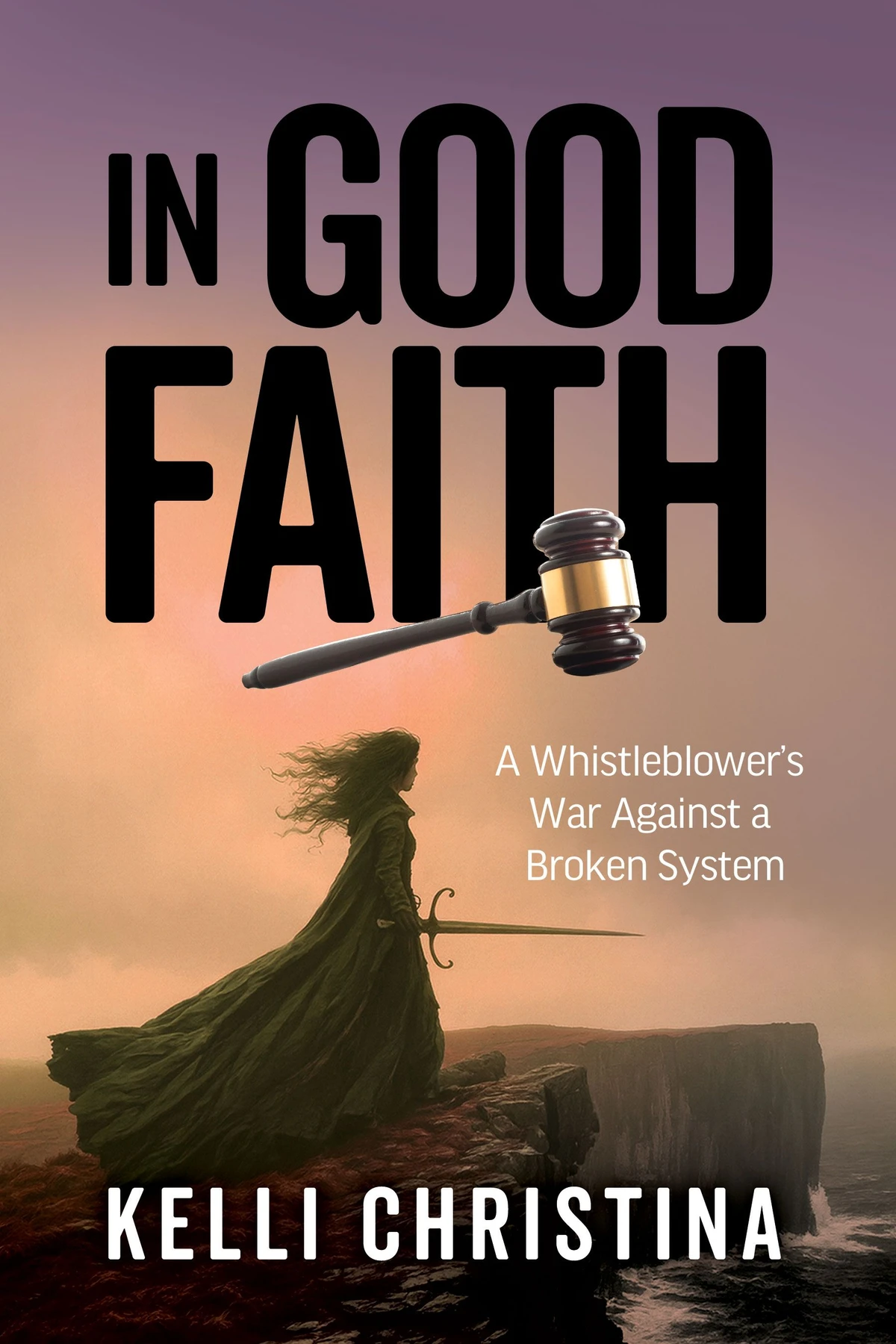
In Good Faith
Quick Take
A passionate whistleblower narrative, In Good Faith exposes the personal, financial, and emotional cost of fighting workplace misconduct and systemic failure from inside a broken professional world.
Short Review
In Good Faith: A Whistleblower’s War Against a Broken System is a narrative nonfiction account of Katheryn Lane, a driven Texas entrepreneur whose work in the medical staffing industry leads her into a destructive maze of workplace misconduct, legal conflict, financial loss, and personal survival. Told through a fictionalized version of the author’s real-life experience, the book blends memoir, legal drama, business warning, and whistleblower testimony.
The book’s strongest material comes from its depiction of workplace collapse. Christina shows how quickly blurred boundaries, leadership failures, office relationships, alleged retaliation, and legal pressure can turn a successful business environment into a hostile and damaging one. Katheryn’s refusal to lie or protect wrongdoing becomes the book’s moral center, and the consequences of that decision drive the story forward.
This is a passionate, highly personal book rather than a detached investigative report. Its directness gives the story urgency, but the prose can be repetitive and emotionally heightened. Some readers may want more outside perspective or a tighter structure. Others, especially those interested in whistleblower stories, employment law, medical staffing, workplace ethics, and survivor narratives, will find the book compelling and disturbing.
At its core, In Good Faith is about what it costs to tell the truth when powerful systems have little incentive to listen.
Full Review
In Good Faith: A Whistleblower’s War Against a Broken System by Kelli Christina is a narrative nonfiction account of professional ambition, workplace collapse, legal conflict, personal survival, and the long emotional cost of becoming a whistleblower. The book is told through the protagonist Katheryn Lane, a fictionalized version of the author’s own experience, with names, identifying details, and some dialogue changed for privacy and narrative flow. The author’s note makes the book’s purpose clear: this is a personal story about business success, alleged negligence, industry misconduct, lawsuits, financial ruin, and the hard lessons that follow when employment law and institutional systems fail the people caught inside them.
The book opens with a tense scene in Washington, DC, where Katheryn seeks help from law enforcement and asks to speak with the FBI. She believes she may be in danger while carrying information connected to fraud, medical staffing practices, and government inaction. This opening gives the book the shape of a legal thriller, even though it is presented as narrative nonfiction. From there, the story moves backward into Katheryn’s rise as a driven Texas businesswoman, her founding of KDC Top Medical Staffing, and the professional partnership that ultimately pulls her into a destructive workplace and legal storm. The table of contents reinforces the book’s broad arc, moving from “FBI Interrogation” and “A Staffing Company Is Born” through lawsuits, displacement, rebuilding, danger, faith, and later public advocacy.
Katheryn is the engine of the book. She is ambitious, outspoken, emotional, entrepreneurial, and unwilling to let injustice pass quietly. The narrative presents her as someone who believes deeply in rules, fairness, hard work, and personal loyalty. That same intensity makes her compelling on the page, though it also gives the book a restless, high-volume energy. She does not move through the story quietly; she pushes, argues, documents, calls attorneys, confronts employers, seeks government help, and keeps fighting even when her finances, health, relationships, and peace of mind collapse around her.
The strongest aspect of In Good Faith is its sense of lived urgency. Christina captures how quickly a workplace can shift from productive and friendly to paranoid, legally dangerous, and emotionally toxic. The early chapters about Markus and Associates are particularly readable because they show the smaller decisions that accumulate into a larger institutional breakdown: inappropriate relationships, workplace gossip, blurred boundaries, leadership failures, alleged retaliation, and the pressure placed on employees to protect the company instead of the truth. Katheryn’s refusal to lie in connection with legal proceedings becomes the moral turning point of the book.
The book also succeeds as a portrait of the hidden personal cost of whistleblowing. It does not treat legal action as clean, glamorous, or easily vindicating. Instead, it shows the slow grind: unpaid commissions, job loss, damaged references, health problems, financial instability, emergency moves, fear, exhaustion, and the difficulty of rebuilding a life after professional collapse. Readers interested in employment law, workplace ethics, business ownership, medical staffing, and whistleblower experiences will find the material direct and emotionally charged.
The limitations are equally clear. The prose is highly dramatic and sometimes repetitive, leaning more toward personal testimony than tightly controlled investigative nonfiction. The book often tells readers what to think about events rather than allowing every implication to emerge through scene and evidence. Its political and legal claims are presented from Katheryn’s perspective, which gives the book passion but may leave some readers wanting more outside framing or a cooler documentary tone. Readers expecting a neutral investigative report may struggle with the book’s intensely personal voice. Readers open to memoir-driven advocacy, however, are more likely to see that intensity as part of the book’s force.
The structure is episodic, moving through business history, romantic complications, lawsuits, survival chapters, travel, faith, and renewed advocacy. This gives the book momentum, but it also means the focus sometimes widens beyond the central whistleblower conflict. Personal relationships, health crises, and spiritual reflections become part of the same war against collapse. For some readers, that breadth will deepen the portrait; for others, it may feel overstuffed.
Still, In Good Faith has a clear audience. It is for readers who respond to survivor narratives, whistleblower stories, workplace injustice, entrepreneurial collapse-and-rebuild journeys, and books about one person challenging systems that appear too large to fight. It is not a quiet book, and it is not a detached one. It is angry, wounded, insistent, hopeful, and determined to turn pain into warning. At its best, it asks a sharp and necessary question: what happens to honest workers when the systems designed to protect them become too slow, too tangled, or too indifferent to help?
Pull Quotes
Content Notes
• Language: Mild to moderate; occasional strong emotional language, but not heavily profane.
• Violence: Mild; includes fear of being followed, threats, and danger, but not graphic violence.
• Sexual Content: Moderate thematic content; workplace affairs, sexual harassment allegations, dating relationships, and adult romantic situations are discussed, but not presented as explicit erotica.
• Drugs/Alcohol: Moderate; includes alcohol use, bar/nightlife scenes, medication references, and addiction/recovery-adjacent material.
• Sensitive Topics: Workplace harassment, alleged fraud, legal conflict, financial ruin, unemployment, health crises, fear, emotional distress, homelessness or near-homelessness, government frustration, and whistleblower retaliation.