
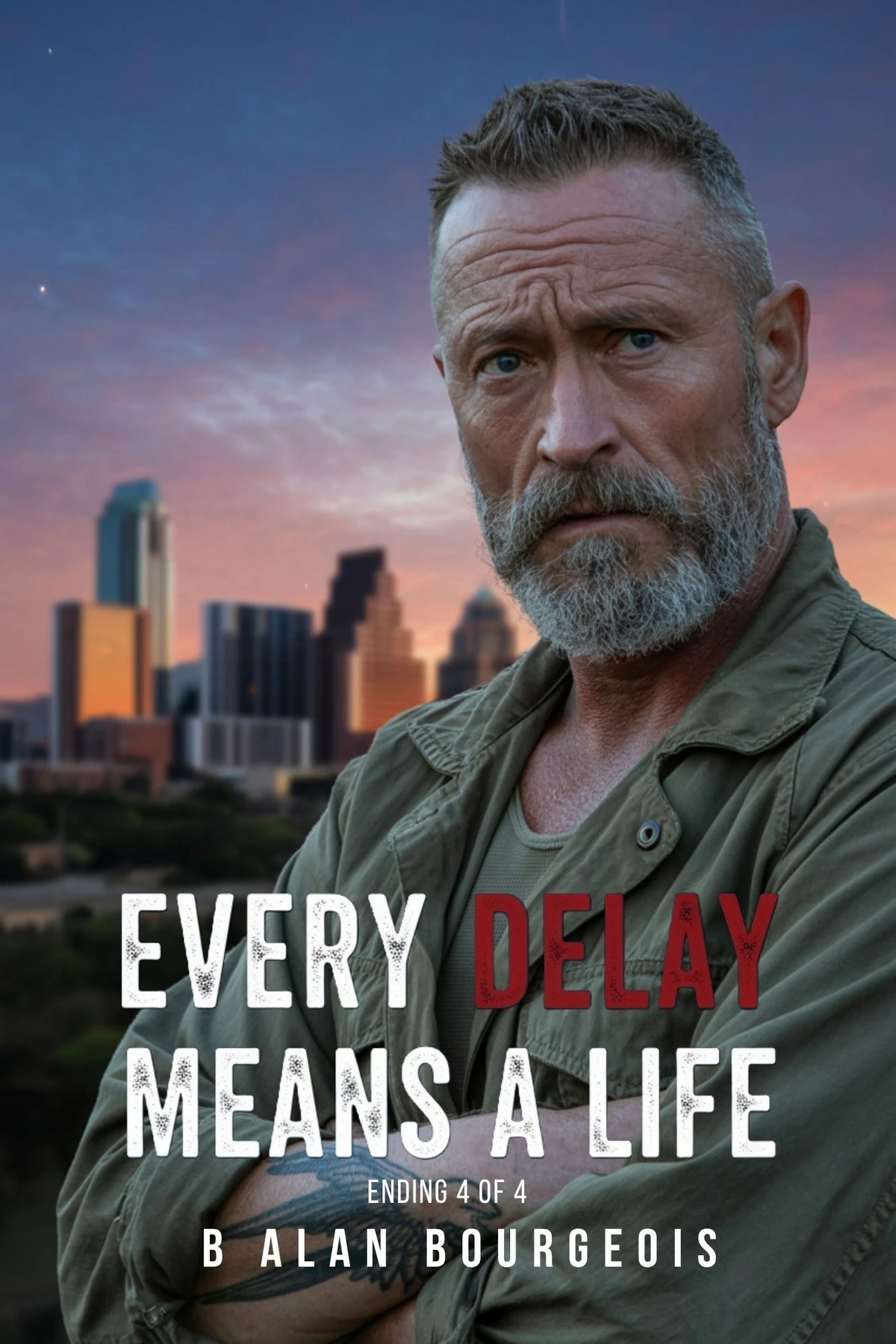
Every Delay Means a Life
Ready to Read It?
Use the button or the permanent True Voice Review purchase link.
TrueVoiceReview.com/b/everydelaymeansalife Scan to Buy the Book
Quick Take
A quiet but relentless social novel, Every Delay Means a Life turns one veteran’s search for a safe parking space into a searing indictment of how cities weaponize delay against the people they’ve already broken.
Short Review
Every Delay Means a Life follows Tom Grady, an unhoused veteran sleeping in his car, through a tightly focused, emotionally charged battle for something incredibly basic: a safe, legal place to park overnight. The novel anchors readers in the daily logistics of survival—where to pee, where to charge a phone, how to avoid “routine” police contacts that can end in disaster—while cutting regularly into the rooms where policy is written and responsibility is diluted. Council meetings, strategy sessions, and media conversations unfold with chilling clarity, showing how human lives are turned into categories, liabilities, and “narrative trends.”
The prose is spare but sharp, filled with recurring phrases and images that gradually build into a quiet, sustained fury. Tom’s interactions with a veteran support group, a determined reporter, and a conflicted council staffer keep the story rooted in people rather than preaching. This is not a plot-twist-driven thriller; it is a social novel with a slow, deliberate burn, more interested in systems than spectacle. Readers who want a fast, escapist read may find the emphasis on policy and process demanding. But for those who care about how cities actually treat their most vulnerable residents, this book delivers a deeply affecting, morally precise story that lingers long after the final page.
Full Review
Every Delay Means a Life is a fiercely focused, quietly devastating novel about one man sleeping in his car and a city that keeps finding new ways to look away. Centered on Tom Grady, an unhoused veteran living out of a worn sedan, the book refuses to make homelessness a backdrop or a “lesson” for more comfortable characters. Instead, it treats Tom’s daily logistics—where to park without being ticketed, where to use a bathroom after midnight, how to stay invisible enough to be safe but visible enough to receive services—as the core drama. The result is a story that feels less like fiction and more like direct exposure to a reality most people step around.
Every Delay Means a Life Ending…
Tom is not a symbol; he is a working system of scars, habits, and stubborn dignity. A veteran with a dry, sardonic wit, he operates on muscle memory from previous campaigns—only now the “field” is discount store parking lots and warehouse zones instead of active duty. What he wants is deceptively simple: a safe, legal place for people who live in their vehicles to park without being treated as trash or threats. What’s at stake, as the novel makes brutally clear, is nothing less than survival. One wrong interaction with police, one “routine courtesy contact” that is neither routine nor courteous, can end in death.
Around Tom, the book builds a layered cast that collectively exposes how systems fail. There is Beck, the counselor who speaks fluent bureaucracy but still remembers that people die between “capacity” and “bandwidth”; Elena Ruiz, a council staffer whose job lives in the gap between city messaging and moral clarity; Maya Chen, a reporter who actually listens; and council members whose language turns human beings into categories, liabilities, and “narrative trends.” The text frequently shifts into these rooms—council chambers, strategy meetings, outreach sessions—to show how policy is manufactured. Those scenes are some of the sharpest in the book, with dialogue that strips political speech down to what it really means: delay, deflection, and protection of power.
The tone is unsentimental but deeply humane. The prose leans on clipped, rhythmic sentences, with key phrases repeated until they hit like blows: “Delay is cheap. Delay is calm. Delay is violent. Because delay kills.” The book is full of this kind of moral precision—lines that are cleanly written but ethically jagged. There are no melodramatic breakdowns, no sanitized uplift; instead, the emotional punches arrive in small, precise moments: a veteran’s joke that hides desperation, a councilmember saying a dead man’s name out loud in a room that would rather talk in euphemisms, a handwritten note on a flyer: “Put bodies in seats so they can’t pretend we’re theory.”
Structurally, the novel is linear but layered. Sixteen chapters carry Tom from the routines of survival through therapy groups, testimony nights, media attention, and a risky attempt to force the city to reckon with car-dwellers as actual residents rather than public-relations problems. The narrative regularly toggles between ground-level scenes in parking lots and higher-altitude views inside city hall and law enforcement, which gives the book both intimacy and scope. Readers who like stories that braid individual struggle with institutional critique will find plenty to sink into here.
The book’s greatest strength lies in its granular realism. It understands homelessness not as an abstract social issue, but as a 24-hour-a-day job of risk management. The descriptions of nighttime parking, the tension around police encounters, the endless forms and “lists” that promise services but deliver delay—all feel lived in rather than researched. That authenticity gives the book a hard-earned authority. When Tom sketches out stages—Simulation, Documentation, Accountability—to push the city into a safe-parking pilot, the plan feels like something that could appear in a real council packet tomorrow.
Every Delay Means a Life Ending…
At the same time, the novel never lets systems completely eclipse people. Group therapy scenes reveal the inner wars veterans carry, with phrases like “moral injury” and “sleep hygiene” rubbing against the raw realities of memory and guilt. A secondary veteran character, Evan, articulates the trap of chasing a version of oneself that never existed, and the counselor’s blunt response cuts through any romanticizing of “resilience.” These scenes ground the book’s political anger in psychological truth.
Every Delay Means a Life Ending…
In terms of limitations, the book is unapologetically focused on process and policy. Much of the tension unfolds in conversations—council meetings, strategy calls, media interviews—rather than in conventional “action” sequences. Readers who prefer twist-driven plots, high physical stakes, or constant external conflict may find the pacing measured, even slow in places. The language of liability, classification, and jurisdiction is deliberately foregrounded; that choice is thematically appropriate, but it also means the book leans more toward social novel than conventional thriller.
For readers willing to stay with its deliberate pacing, Every Delay Means a Life offers a powerful, clear-eyed indictment of how cities manage homelessness—and a deeply human portrait of one man who refuses to vanish quietly. It is angry without being hysterical, compassionate without being sentimental, and unflinching about the costs of delay. This is the kind of book that may not comfort many readers, but it will stay under their skin and change how they look at every car with fogged-up windows in a parking lot at night.
Pull Quotes
Content Notes
• Language: Moderate strong language, including occasional profanity; no repeated slurs.
• Violence: Non-graphic but intense; includes police encounters, a death linked to displacement, and descriptions of systemic harm.
• Sexual Content: Minimal; no on-page sexual activity or explicit scenes.
• Drugs/Alcohol: References to substance use in the context of homelessness and veteran experience; no glamorization, largely off-page.
• Sensitive Topics: Homelessness, PTSD and veteran trauma, systemic neglect, death in custody or following police contact, mental health strain, and institutional betrayal.