
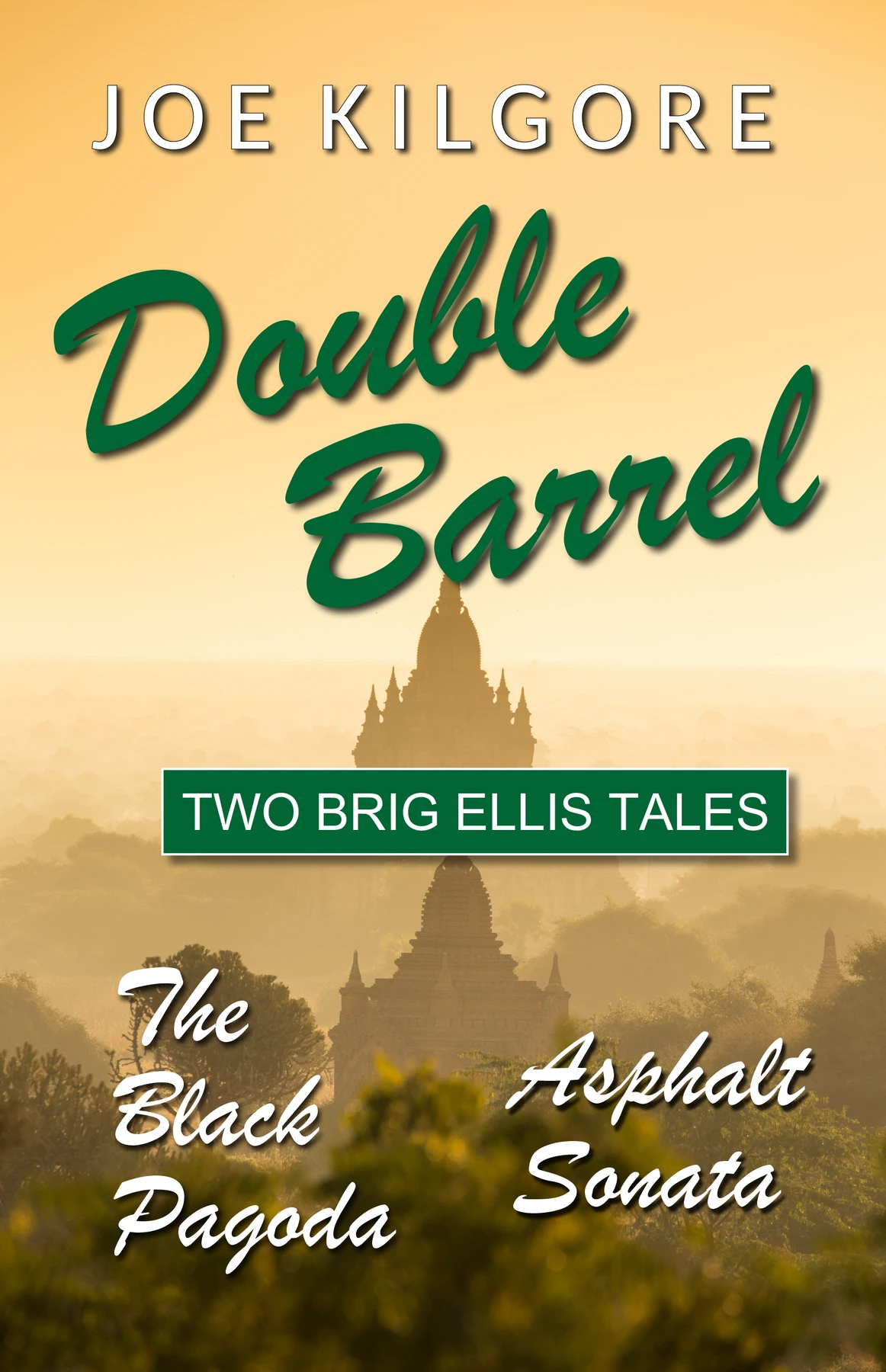
Double Barrel: Two Brig Ellis Tales
Quick Take
(Primary)
Short Review
Double Barrel: Two Brig Ellis Tales gives private investigator Brig Ellis two dangerous assignments with little in common except escalating body counts, compromised institutions, and clients who have not told him everything.
In The Black Pagoda, Ellis travels from San Diego to Bangkok to locate Walter Ramirez, an old Army friend and police detective who vanished after an international conference. Working with sharp-tongued Detective Niran Du, Ellis follows the disappearance into a criminal network involving murder, trafficking, corruption, and organized violence.
Asphalt Sonata places Ellis on Route 66 as security for Richard Baines, an irascible former literary celebrity launching an unlikely comeback. What begins as a publishing stunt becomes a serial-killer investigation when women connected to the tour are murdered and signed copies of Baines’s novel appear beside the victims.
Joe Kilgore writes in a brisk, old-fashioned crime style filled with banter, profanity, action, alcohol, and hard moral choices. Ellis is an appealing lead: competent, sardonic, loyal, and increasingly aware that solving a case does not guarantee a just outcome. Du and Baines provide strong but contrasting foils, giving the two tales their own personalities.
Some readers may find the explanatory passages, repeated murder interludes, cultural generalizations, sexual commentary, and abrasive character language dated or excessive. Those comfortable with hard-edged thrillers will find an ambitious double feature combining international crime, literary satire, road adventure, and noir-inflected moral uncertainty.
Full Review
Joe Kilgore’s Double Barrel: Two Brig Ellis Tales pairs two substantial crime stories built around Brig Ellis, a San Diego private investigator whose military background, flexible relationship with authority, and instinctive loyalty repeatedly draw him into assignments far more dangerous than their initial descriptions suggest. The collection contains The Black Pagoda and Asphalt Sonata, two independent adventures linked by Ellis’s hard-boiled voice, dry humor, and uneasy willingness to enter moral territory where clean answers are scarce.
In The Black Pagoda, Ellis receives a call from the wife of Walter Ramirez, an old Army friend and San Diego police detective who has disappeared after attending an international law-enforcement conference in Bangkok. Ellis travels to Thailand expecting to retrace Walter’s movements. Instead, he encounters Detective Niran Du, an irreverent local officer who may know considerably more than he initially reveals. Their investigation leads from hotels and nightlife districts into a widening network of murder, trafficking, corruption, cybercrime, and organized violence. What begins as a missing-person case becomes a confrontation with a criminal enterprise whose influence reaches far beyond Bangkok. Ellis’s refusal to abandon Walter remains the emotional anchor even as the plot expands into international-thriller territory.
Asphalt Sonata shifts into a distinctly American setting and adopts the shape of a Route 66 road thriller. Ellis is hired to protect Richard Baines, an aging, once-celebrated novelist whose newly discovered manuscript has placed him back in the publishing spotlight. Baines is cantankerous, theatrical, frequently drunk, and far less fragile than his handlers assume. A promotional tour from Chicago to California initially appears to be an eccentric literary road trip. Then women connected to the tour begin dying, signed copies of Baines’s novel appear near the victims, and Ellis finds himself traveling beside a possible target—or suspect—while local police, federal agents, publishers, and publicity professionals compete for control of the situation. The premise offers a clever collision of publishing satire, serial-killer suspense, and classic highway fiction.
Ellis is the collection’s strongest unifying element. He is capable without being invulnerable, cynical without being entirely hardened, and funny without turning every dangerous moment into a joke. His investigative methods rely as much on reading people as gathering evidence. More importantly, his loyalty has consequences. He is not merely solving puzzles; he is repeatedly forced to decide what friendship, justice, and personal responsibility require when institutions are compromised or ineffective.
The supporting partnerships give each story a different energy. Du’s street knowledge and verbal sparring make The Black Pagoda an effective buddy investigation, while Baines’s grandiosity turns Asphalt Sonata into an argumentative road trip between two men who distrust pretension but recognize something valuable in each other. Baines is especially memorable: abrasive, intelligent, self-mythologizing, and unexpectedly perceptive about mortality, artistic ambition, and the compromises surrounding commercial publishing.
Kilgore writes in an old-school, wisecracking crime style. The prose favors brisk dialogue, punch-line observations, cliffhanger chapter endings, and occasional narrative asides. The plotting is generally linear and accessible, although both stories expand well beyond their initial mysteries. The Black Pagoda becomes increasingly action-driven and morally complicated, while Asphalt Sonata alternates between Ellis and Baines on the road and unsettling glimpses of people caught in the killer’s path. That structure creates suspense, though the repeated victim-centered interludes may feel grim or formulaic to some readers.
The collection is strongest when its humor and darkness occupy the same scene. Ellis can trade insults over drinks, admire an unfamiliar landscape, and moments later face a decision that leaves permanent emotional damage. Beneath the gunfire and banter lies a persistent concern with accountability: whether people can excuse their actions as duty, fate, ambition, obedience, or necessity, and what remains when those explanations fail. The stories do not pretend that restoring order necessarily restores innocence.
Some elements will narrow the audience. The dialogue contains frequent profanity, sexual references, slurs, and intentionally abrasive humor. Certain descriptions of women, sex workers, LGBTQ people, ethnicity, and foreign culture are delivered through blunt, sometimes stereotyped character perspectives. Readers who prefer contemporary sensitivity in crime narration may find portions dated or needlessly provocative. The plots also pause for explanatory dialogue about criminal systems, geography, publishing, and law enforcement, which can slow an otherwise energetic pace.
For readers comfortable with hard-edged material, however, Double Barrel delivers two muscular, entertaining thrillers with sharply differentiated settings. It combines private-eye fiction, international intrigue, literary satire, road narrative, and action suspense without losing sight of the damaged but determined investigator at its center. Brig Ellis emerges as a protagonist capable of sustaining further adventures—not because he always makes the right decision, but because he understands that every decision eventually sends a bill.
Pull Quotes
Content Notes
Language: Strong and frequent profanity; includes sexual language and homophobic and other derogatory slurs.
Violence: Frequent and occasionally graphic; shootings, strangulation, stabbing, beatings, explosions, murder, and threatened mass violence.
Sexual Content: Sexual references and explicit dialogue; nudity, prostitution, sexualized environments, and some on-page but generally non-erotic sexual activity.
Drugs/Alcohol: Frequent alcohol consumption; drug trafficking, involuntary drugging, addiction references, and recreational drug activity.
Sensitive Topics: Human trafficking, sexual exploitation, murder, corruption, terrorism, torture, suicide-related material, bigotry, gender identity, grief, trauma, and mental illness.