
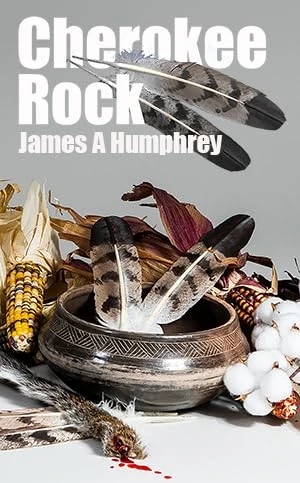
Cherokee Rock
Quick Take
A sweeping Indigenous historical fantasy, Cherokee Rock follows a grieving Cherokee boy’s journey toward healing, resistance, and spiritual purpose amid disease, violence, and colonial expansion.
Short Review
James A. Humphrey’s Cherokee Rock is a sweeping historical fantasy set during the violent years of Cherokee resistance, colonial expansion, epidemic disease, and political fracture. The story follows Enoli, a young Cherokee boy who loses his mother to smallpox and is forced into adulthood while his community faces attacks, displacement, and conflict over how to survive a changing world.
At the center of the novel is Enoli’s relationship with Saloli, a talking squirrel who serves as guide, companion, skeptic, and protector. Their bond gives the story its most memorable emotional dimension. Through Saloli’s sharp humor and Enoli’s grief-driven determination, the novel explores the cost of violence, the danger of unchecked authority, and the difference between healing and merely holding power.
The book’s historical ambition is substantial. It moves through Cherokee councils, resistance movements, treaty negotiations, spiritual traditions, and the pressures created by colonial settlement. Humphrey clearly wants readers to encounter Cherokee history as lived experience rather than distant background, and the novel’s recurring use of Cherokee language and cultural references supports that goal.
Its greatest strength is its scope and purpose. Its main limitation is that the narrative can become episodic, with historical explanation sometimes competing with character momentum. Readers looking for a fast-paced adventure may need patience, but those drawn to Indigenous-centered historical fiction, spiritual conflict, and stories of survival will find much to engage with.
Full Review
Cherokee Rock is a wide-ranging historical fantasy that begins in 1780 amid Cherokee communities facing epidemic disease, colonial violence, internal political division, and the accelerating loss of ancestral lands. James A. Humphrey centers the novel on Enoli, a ten-year-old Cherokee boy whose childhood is shattered when his mother falls ill with smallpox and his village is attacked. What follows is both a coming-of-age story and an epic conflict over medicine, belief, leadership, land, and cultural survival.
The early pages establish the book’s central tension with unusual force. Enoli is pushed toward adulthood before he is ready, first by the absence of his father and then by the crisis surrounding his mother. The world around him is divided between leaders urging peace, warriors preparing for resistance, and spiritual figures whose authority is increasingly tested by new diseases and colonial expansion. Humphrey uses this conflict to place Enoli’s personal grief inside a larger historical question: how can a people survive when every path forward appears dangerous?
The novel’s most distinctive element is Saloli, the talking squirrel who becomes Enoli’s companion, critic, protector, and unlikely moral counterweight. Saloli brings humor to an otherwise grim opening, but the character is more than comic relief. Through the squirrel’s blunt commentary, the story questions human violence, ego, politics, superstition, and the misuse of spiritual authority. The friendship between Enoli and Saloli gives the book warmth and imaginative energy, particularly as Enoli begins his journey toward becoming a healer.
That journey introduces one of the novel’s strongest themes: the conflict between tradition and change. Enoli’s early experience with Mohi, a medicine man whose methods prove harmful and whose ambitions become increasingly troubling, drives much of the book’s emotional and moral momentum. In contrast, Enoli encounters more disciplined healing practices through the son of Stone Cloud, whose approach emphasizes observation, restraint, isolation of contagious illness, and minimizing harm. The book is not simply rejecting Cherokee spiritual tradition in favor of Western knowledge; it is more interested in the danger of any authority figure who values prestige, control, or ideology over human life.
Humphrey gives the story considerable historical scope. The novel moves through Cherokee political struggles, the violence surrounding Dragging Canoe’s resistance, treaty negotiations, disease outbreaks, conflicts with settlers, shifting alliances, and later encounters with figures and movements tied to Indigenous resistance across the region. This gives Cherokee Rock the feel of a historical chronicle as much as a character-driven novel. Readers interested in eighteenth- and early nineteenth-century Cherokee history will find an ambitious attempt to dramatize a period too often reduced to a few familiar names or events.
The book also makes a visible effort to weave Cherokee language, spiritual concepts, and cultural references into the narrative. Cherokee terms are often presented with pronunciation guidance, and the recurring presence of Unetlanvhi, Cherokee Rock, clan identity, council traditions, and healing practices gives the novel a strong sense of cultural intent. The author’s preface frames the work as fiction meant to encourage awareness of Cherokee history, culture, and language, and that purpose is evident throughout.
Enoli is most compelling when he is caught between helplessness and responsibility. He is not introduced as a chosen hero in the simplistic sense; he is a grieving child who is frightened, angry, impulsive, and often overwhelmed. His eventual desire to become a healer gives the novel an emotional anchor. Even as the narrative widens into war, politics, treaty conflict, spiritual struggle, and revenge, Enoli’s core question remains understandable: what does it mean to protect people when the world keeps taking them away?
The book’s limitations largely come from its ambition. With forty-four chapters and a long historical span, Cherokee Rock frequently shifts from intimate scenes into broader political explanation, military context, and philosophical debate. That scope gives the novel richness, but it can also slow the pace. Some dialogue is highly explanatory, especially when characters discuss historical events, treaties, beliefs, or political motives. Readers who prefer tightly compressed historical fiction may find the narrative more episodic than immersive at times.
The prose is direct, vivid, and often dramatic. Humphrey does not soften the horrors of the era: smallpox, massacre, child death, scalping, displacement, betrayal, and violence appear early and recur throughout. Yet the novel is not without hope. Its strongest emotional current is a belief that survival depends not only on resistance but on memory, ethical responsibility, and the willingness to learn.
Cherokee Rock will work best for readers who enjoy Indigenous-centered historical fiction with spiritual and fantastical elements, especially those drawn to stories of survival during colonial expansion. It is a serious, often brutal novel, but also one with genuine heart. Enoli’s bond with Saloli and his search for a better form of healing give the story its humanity amid a landscape shaped by loss.
Pull Quotes
Content Notes
• Language: Moderate historical language; includes derogatory and period-specific references connected to colonial violence and racism.
• Violence: Graphic at times; includes smallpox illness, bloodletting, murder, scalping, child death, massacre, armed attacks, and war violence.
• Sexual Content: Minimal to none on-page.
• Drugs/Alcohol: Limited; some references to alcohol and tobacco use.
• Sensitive Topics: Epidemic disease, death of a parent, child endangerment, colonial violence, displacement, racism, cultural loss, grief, betrayal, and spiritual trauma.