
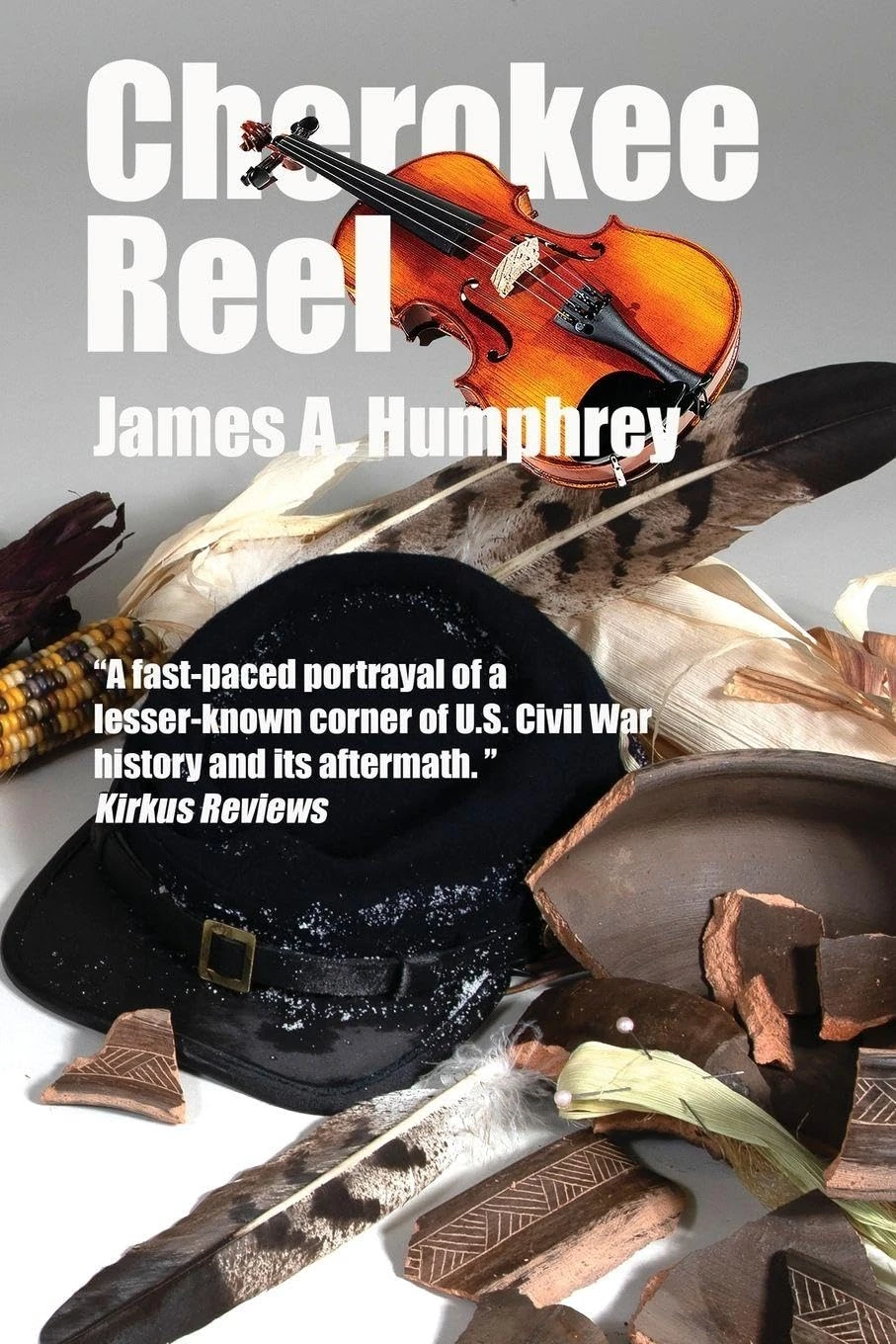
Cherokee Reel
Quick Take
A sweeping historical drama, Cherokee Reel follows Cherokee, freedmen, and mixed-heritage lives through slavery, war, political division, and survival in a changing nineteenth-century Indian Territory.
Short Review
James A. Humphrey’s Cherokee Reel is an ambitious historical drama set across the turbulent decades of Cherokee and American history surrounding slavery, removal, civil conflict, and Reconstruction. Centered on Lisa Waters, her husband Ezra, and the freedman musician Moss, the novel follows lives shaped by political division, racial injustice, private grief, and the ongoing struggle for freedom.
Lisa begins the story as a socially influential Cherokee woman living comfortably near Fort Smith, Arkansas. Her world changes when family tragedy and the realities of slavery force her to confront the limits of status, silence, and safety. Moss, a fiddler with ties to an escape network, gives the book its most immediate sense of danger as he guides people fleeing enslavement. Ezra, a formerly enslaved attorney, adds another layer of complexity as he balances professional success, legal risk, and moral responsibility.
The strongest feature of Cherokee Reel is its historical reach. Humphrey brings Cherokee political factions, freedmen, abolitionist resistance, military conflict, women’s roles, railroads, and postwar development into one broad narrative. The novel is particularly effective when it shows history not as distant background but as a force shaping marriages, friendships, livelihoods, and survival.
The book’s scale is both a strength and a limitation. Its many chapters, historical events, and shifting priorities give it richness, but the pacing can feel episodic. Some readers may also find the dialogue and historical explanation more direct than subtle. Still, readers interested in Indigenous-centered historical fiction, Civil War-era stories, and narratives of resistance will find a substantial and heartfelt work here.
Full Review
Cherokee Reel is an expansive historical novel that follows Cherokee, freedmen, and mixed-heritage characters through decades of upheaval in the American South and Indian Territory. James A. Humphrey builds the story around Lisa Waters, a socially ambitious, politically observant Cherokee woman; her husband Ezra, a formerly enslaved attorney and businessman; and Moss, a gifted fiddler whose music becomes connected to a dangerous freedom network. Their lives unfold against the long shadow of Cherokee removal, slavery, factional conflict, the Civil War, Reconstruction, and the economic transformation of Indian Territory.
The novel opens in Fort Smith, Arkansas, where Lisa and Ezra host a lavish social gathering attended by influential figures from Cherokee political life. The setting is immediately charged by cultural and political division: Cherokee factions occupy the same room but do not trust one another; wealthy landowners, military officials, freedmen, and political leaders all move through the same social world with vastly different stakes. Lisa initially appears comfortable in that environment. She enjoys influence, style, competition with other prominent women, and the visibility that comes with her husband’s success.
That confidence is disrupted by the arrival of her sister Ella, a woman remembered as the “Cherokee Rose” for past courage but now struggling with trauma and alcohol. Ella’s fate becomes one of the novel’s first emotional turning points, forcing Lisa to confront questions of shame, loyalty, survival, and the cost of protecting appearances. From there, Cherokee Reel widens into a generational story of resistance and consequence.
The title functions as more than a musical reference. The Cherokee Reel becomes a symbol of movement, memory, coded resistance, and cultural survival. Moss’s music and his work assisting escapees give the story its moral center early on. Lisa and Ezra are drawn into danger when they choose whether to protect people fleeing enslavement, and that choice reshapes their position within a society divided by race, wealth, and allegiance. The book’s portrayal of resistance is strongest when it shows courage as something practical: sheltering people, protecting information, risking reputation, and continuing despite fear.
Humphrey’s greatest strength is scope. The novel covers a large historical canvas while maintaining a consistent interest in the people who are often pushed to the margins of more conventional frontier narratives. Cherokee political conflict, Indigenous displacement, slavery, freedmen’s rights, armed resistance, women’s social constraints, business development, railroads, and coal mining are all woven into the plot. The result is a book with genuine ambition. Readers who enjoy historical fiction that treats the nineteenth-century American West as a contested, culturally complex place will find much to engage with.
Lisa is especially compelling because she is not presented as a simple heroine. She begins as someone who values status and presentation, but her life gradually demands more from her. Her journey involves grief, political awakening, leadership, and the difficult work of choosing what kind of legacy she wants to build. Ezra provides an important counterpoint as a Black man who has moved from enslavement into professional and economic influence, while Moss carries much of the novel’s urgency through his connection to freedom work and armed resistance.
The structure is episodic and wide-ranging. With more than forty chapters, the story spans years and repeatedly shifts its attention from personal crisis to political conflict, military action, public events, and later economic struggles. That breadth allows Humphrey to explore substantial historical change, but it can also make the book feel more like a historical chronicle than a tightly concentrated character novel. Readers looking for a fast, singular plot may find the pacing uneven, particularly in the later sections where business conflicts and community development receive considerable attention.
The prose is descriptive, direct, and often theatrical in its dialogue. Historical figures and fictional characters share scenes, and the book is clearly interested in dramatizing how personal relationships intersect with public history. At times, the dialogue leans explanatory, delivering political and historical context openly rather than allowing readers to infer it. For many historical-fiction readers, especially those less familiar with Cherokee history, that accessibility will be an advantage. Others may prefer more restraint and a more streamlined narrative focus.
The novel’s emotional weight comes from its refusal to soften the era. Violence, racial oppression, forced removal, sexual threat, addiction, warfare, betrayal, and grief are central to the world of the book. Yet the overall arc remains invested in endurance rather than despair. The story repeatedly returns to the possibility of restoration, community, and survival after profound loss.
Cherokee Reel is best suited to readers who want a long-form historical drama rooted in Cherokee history and the complicated intersections of Indigenous identity, Black freedom, political conflict, and frontier development. It is not light historical fiction, nor is it a simple romance disguised as history. Its appeal lies in its breadth, its commitment to underexplored perspectives, and its effort to place personal lives inside the hard realities of nineteenth-century American expansion. The novel’s opening establishes its central concerns with Cherokee political division, slavery, social hierarchy, and the moral stakes surrounding freedom; the later narrative carries those tensions through war, Reconstruction, and changing economic realities.
Pull Quotes
Content Notes
• Language: Moderate historical language; includes period-appropriate racial terminology and derogatory references connected to slavery and conflict.
• Violence: Moderate to graphic at times; includes murder, pistol-whipping, threats, armed conflict, battlefield violence, executions, and war-related deaths.
• Sexual Content: Implied sexual assault, prostitution, sexual threat, and adult relationship material; no sustained explicit sex scenes.
• Drugs/Alcohol: Moderate; recurring alcohol use, drunkenness, and alcoholism are important to the early story.
• Sensitive Topics: Slavery, forced removal, racism, Indigenous displacement, murder, war trauma, grief, addiction, sexual violence, political persecution, and family loss.