
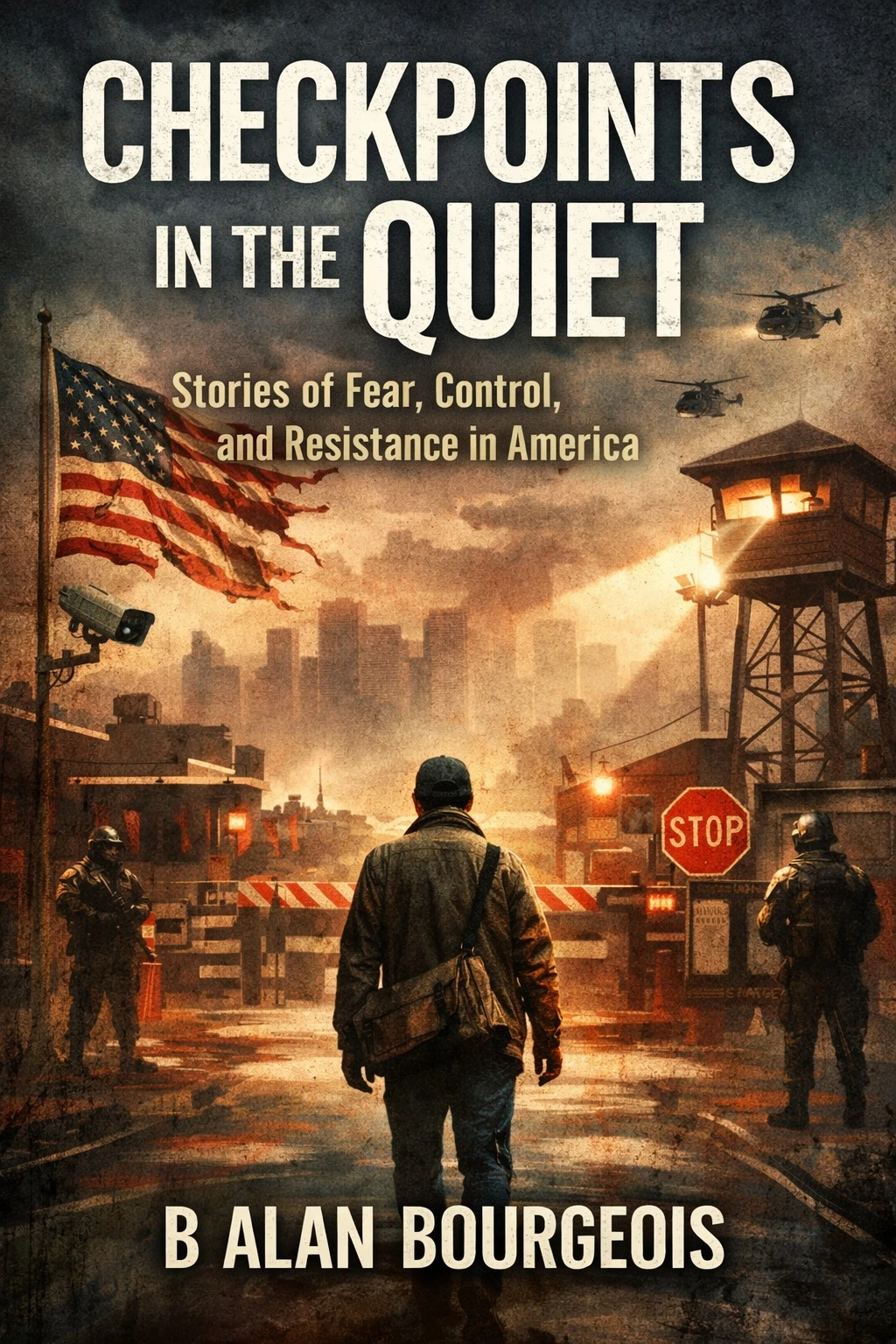
Checkpoints in the Quiet
Quick Take
A tense, politically explicit collection, Checkpoints in the Quiet turns surveillance, bureaucratic cruelty, and social abandonment into near-future fiction that feels less invented than ominously adjacent.
Short Review
Checkpoints in the Quiet is a linked collection of politically charged stories about fear, bureaucracy, surveillance, and resistance in a near-future America that feels uncomfortably close to the present. The book moves from economic precarity and the failure of performative kindness in “The Kindness That Peels Off” to the nightmare civility of “The Quiet Checkpoint,” where a children’s author discovers that “author status” has become a trigger for state scrutiny. From there, the collection expands into digital erasure, detention scoring, activist networks, and public resistance against systems designed to disappear people cleanly and quietly.
Bourgeois writes in a plain, accessible style that prizes urgency and clarity. The strongest sections are the ones grounded in ordinary settings—a library desk, a municipal office, a motel room, a laptop login, a community gathering—where the machinery of control feels procedural rather than theatrical. That emphasis gives the book its strongest effect: it shows how authoritarianism can arrive through systems that insist they are only trying to keep things “safe and accurate.”
Readers who enjoy overtly political dystopian fiction, civic-warning narratives, and resistance stories with clear moral stakes will find a strong hook here. Readers who prefer subtle politics, more ideological ambiguity, or lighter tonal range may find the book relentless and sharply didactic in places. Even so, it is a memorable, purposeful work with a clear audience and real conviction behind it.
Full Review
Checkpoints in the Quiet is a linked collection of political fiction that reads less like a conventional short-story volume and more like a coordinated alarm system. Across nine pieces, B Alan Bourgeois imagines a near-future America in which bureaucratic friction, digital surveillance, civic intimidation, economic precarity, and state-sanctioned erasure have become ordinary tools of control. The table of contents signals that architecture clearly, moving from “The Kindness That Peels Off” and “The Quiet Checkpoint” through “The Firestarter,” “The Spark in the Circuit,” “Code of Silence,” “The Double Betrayal,” “Where the Birds Fly Wrong,” “Murals on the Run,” and “The Last Chapter.”
The opening piece, “The Kindness That Peels Off,” sets the book’s emotional and political frame with unusual force. Its narrator, Daniel Voss, is not simply poor or struggling; he is trapped in the humiliating gap between symbolic compassion and structural help. The story’s power comes from how precisely it distinguishes charity from rescue, admiration from commitment, and good intentions from material interruption of harm. It is a morally direct story, but not a simple one. Its anger is sharpened by exhaustion, age, and lived knowledge, which gives the collection an immediate human center rather than a purely ideological one.
The book’s second major strand, centered on Dana Whitlock in “The Quiet Checkpoint,” shifts from economic precarity to authoritarian creep. Dana, a children’s author and library volunteer, is drawn into a chilling “verification” system after her library account is flagged for “author status.” What makes this section work is not spectacle but procedural menace: polite language, municipal blandness, compliance scripts, and the terrifying discovery that books for children can be categorized as risk. The scene work around Checkpoint 12 is among the book’s strongest material because it understands that authoritarianism often arrives as process, not performance.
Later sections widen the scope into overt resistance and tech-enabled repression. The Kellan and Cairo material, particularly in “Murals on the Run,” introduces a more thriller-oriented register in which erasure begins with digital friction: logins fail, feeds disappear, credibility is quietly dismantled, and targeted people are made to seem unreliable before they are made fully absent. That shift gives the collection a broader narrative engine while staying loyal to the book’s central preoccupation with systems that punish visibility. The excerpts from “The Spark in the Circuit” and later sections about Gabriel Solís push the book toward activist dystopian fiction, bringing in AI optimization, detention scoring, public protest, corporate-state collusion, and a final insistence that truth must become physical when digital platforms can be wiped clean.
Stylistically, Bourgeois favors clarity over ornament. The prose is accessible, direct, and emotionally legible, with a strong preference for declarative sentences and high-contrast moral stakes. The stories are built around scenario, pressure, and revelation more than subtle ambiguity. That approach works well when the goal is urgency. Readers are rarely uncertain about what is at stake, who is being targeted, or what kind of damage the system is built to do. The linked-story structure also helps the book feel cumulative; each piece adds a new face to the same political weather.
The book’s greatest strength is its ability to turn abstract civic fear into concrete, lived experience. A library card becomes a trap door. A children’s book becomes a flagged object. A mutual-aid page disappears. A risk score turns a human life into sortable data. A person struggling to survive poverty becomes a case study in how communities confuse kindness with inconvenience-free self-regard. These are sharp, memorable translations of policy and ideology into ordinary life.
The limitations are also clear. This is a politically explicit book, and it is not interested in disguising its worldview. Some readers will find that invigorating; others will find it heavy-handed. The characters often function as witnesses, targets, or resisters inside a larger argument, which can reduce tonal variety and occasionally narrow the sense of surprise. Readers looking for subtle literary indirection or ideological ambiguity may find the book more declarative than exploratory. Its power comes from conviction, but conviction can also flatten nuance for readers who prefer fiction to leave more moral space open.
Still, Checkpoints in the Quiet succeeds at what it is trying to be: a warning document in fictional form. It is not comfort reading, and it does not want to be. It is built for readers who want politically charged, near-future fiction that names the mechanics of fear plainly and refuses to treat civic erosion as background noise. At its best, the book feels less like speculative dystopia than like a series of plausible escalations presented before the reader has the luxury of calling them hindsight.
Pull Quotes
Content Notes
• Language: Moderate to strong; recurring profanity including “hell,” “damn,” and stronger political anger in dialogue and narration.
• Violence: Moderate; threat-based and institutional violence, arrests, detention, coercion, implied disappearances, and protest-state confrontation rather than frequent graphic gore.
• Sexual Content: None to minimal in the reviewed material; no clear explicit on-page sexual scenes found.
• Drugs/Alcohol: Minimal in the reviewed material; not a major content driver.
• Sensitive Topics: Homelessness and economic collapse, censorship, surveillance, political persecution, detention systems, authoritarian control, digital erasure, discrimination, and civic fear.