
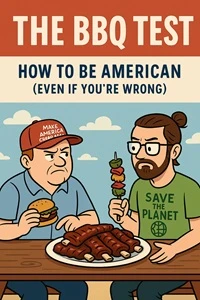
BBQ Test
Ready to Read It?
Use the button or the permanent True Voice Review purchase link.
TrueVoiceReview.com/b/bbqtest Scan to Buy the Book
Quick Take
A punchy, chapter-by-chapter political satire that roasts both sides and ends in hope, BBQ Test argues the country survives when Americans can still laugh, listen, and share a table.
Short Review
BBQ Test: How To Be American (Even if You are Wrong) is a fast-moving collection of political satire essays built around a simple idea: if Americans can still share a backyard barbecue with people they disagree with, the country still has a chance. Each chapter tackles a hot-button topic—speech, guns and faith, immigration, taxes, policing, outrage culture, history, identity—and runs it through a consistent comedic pattern: “MAGA’s version,” “liberals’ version,” the shared irony, and a closing “Fix” that argues for tolerance and perspective.
The writing leans into stand-up cadence and cultural shorthand, making the book easy to dip into and highly quotable. Its biggest strength is accessibility: it’s designed for readers who are worn down by polarization and want humor that also points toward coexistence. The book’s balanced approach—skewering both sides—will be a feature for readers who want temperature-lowering satire and a drawback for readers who see the current moment as too unequal for even-handed jokes. The predictable chapter structure also makes it readable but occasionally repetitive.
For audiences who enjoy civic-minded comedy with a hopeful spine—more “laugh and breathe” than “debate and destroy”—BBQ Test delivers a clear premise, sharp punchlines, and an insistence that democracy starts with sharing the table.
Full Review
BBQ Test: How To Be American (Even if You are Wrong) is a brisk, punchline-driven work of political satire that treats modern American life as one long neighborhood cookout where everyone is convinced they’re the sane one. Structured as a sequence of themed essays—free speech, guns and religion, immigration, taxes, policing, outrage culture, identity politics, “history wars,” and more—the book uses a consistent comic framework: it sketches how “MAGA America” approaches an issue, how “liberals” approach the same issue, then lands on the shared contradiction and ends with a “Fix” that urges tolerance, humility, and a return to basic civic coexistence.
The premise is simple and effective: if democracy is going to survive the era of algorithm-fed anger, people have to relearn how to disagree without trying to destroy each other. The “BBQ Test” itself becomes the guiding metaphor—if someone can argue across the fence and still pass the plate, they pass; if politics has made them unable to share a table, the country has a problem. That central image is easy to grasp, easy to quote, and broad enough to hold the book’s many topics.
Tone is where the book places its bet: playful, sharp, and deliberately accessible, with frequent cultural references and a stand-up-comedy rhythm that makes it read fast. The humor tends to work through exaggeration and mirror-holding—each side gets skewered for selective outrage, selective memory, and selective “freedom.” The jokes are built to be readable in short bursts, and most chapters can be sampled on their own without losing the thread. That modular structure also makes the book usable for casual readers who don’t want to commit to a continuous narrative, as well as for book clubs looking for bite-sized discussion starters.
A major strength is how clearly the book communicates its target: not the hardened ideologue, but the exhausted citizen who wants relief from the national doomscroll. It’s written for readers who still have family on “the other side,” who are tired of being told to sever relationships, and who suspect that the loudest voices on both ends are rewarded for conflict. In that lane, the book’s biggest asset is clarity: it says what it’s doing, it repeats its structure reliably, and it makes the argument that civility is not weakness. The recurring “Fix” sections keep the message from turning into pure roast-comedy; the book wants laughter to be a bridge back to shared life, not just a weapon.
The themes underneath the humor are more serious than the jokes might suggest: identity, belonging, personal responsibility, and the recognition that hypocrisy is not a partisan defect but a human default. The foreword’s framing—written in the shadow of a real-world political killing—adds gravity to the project’s motivation without turning the book into a lecture. The result is a tonal blend that many readers will find energizing: jokes with a pulse of real concern beneath them.
The style’s biggest tradeoff is that the book is intentionally “both-sides” in presentation. For readers who believe the current crisis is asymmetrical—one side uniquely dangerous, uniquely dishonest, or uniquely responsible—the even-handed skewering may feel like false equivalence. Others will find that balance to be exactly the point: a satire built to lower the temperature, not win a case. Similarly, the chapter formula is a strength for readability but can feel repetitive for cover-to-cover readers. The rhythm is dependable—setup, contrast, irony, fix—which makes it highly skimmable but occasionally reduces surprise.
Another likely friction point is the book’s reliance on contemporary cultural touchstones (brands, public figures, recent controversies). That gives the comedy immediacy, but it also means some jokes are tied to a specific moment in American discourse. For many satire readers, that’s part of the fun; for others, it can read like topical shorthand rather than timeless humor. The book’s tone also leans breezy in places where the subject matter is heavy, which will work for readers who want laughter as relief and may not work for readers who want deeper analysis.
Ultimately, BBQ Test is best understood as a satirical civic-reset: a quick, quotable read designed to make people laugh, wince, and—ideally—stop treating neighbors like enemies. It won’t convert the committed partisan, but it isn’t trying to. It’s trying to keep the rest of the country from tearing itself apart over the potato salad.
Pull Quotes
Content Notes
• Language: Mild; occasional coarse phrasing and insults used for comedic effect.
• Violence: None depicted; brief mention of real-world political violence in framing context.
• Sexual Content: None.
• Drugs/Alcohol: Mild; casual references to beer/drinks in the barbecue framing.
• Sensitive Topics: Political polarization, extremism rhetoric, civic conflict, identity politics, and a brief reference to political murder as motivating context.