
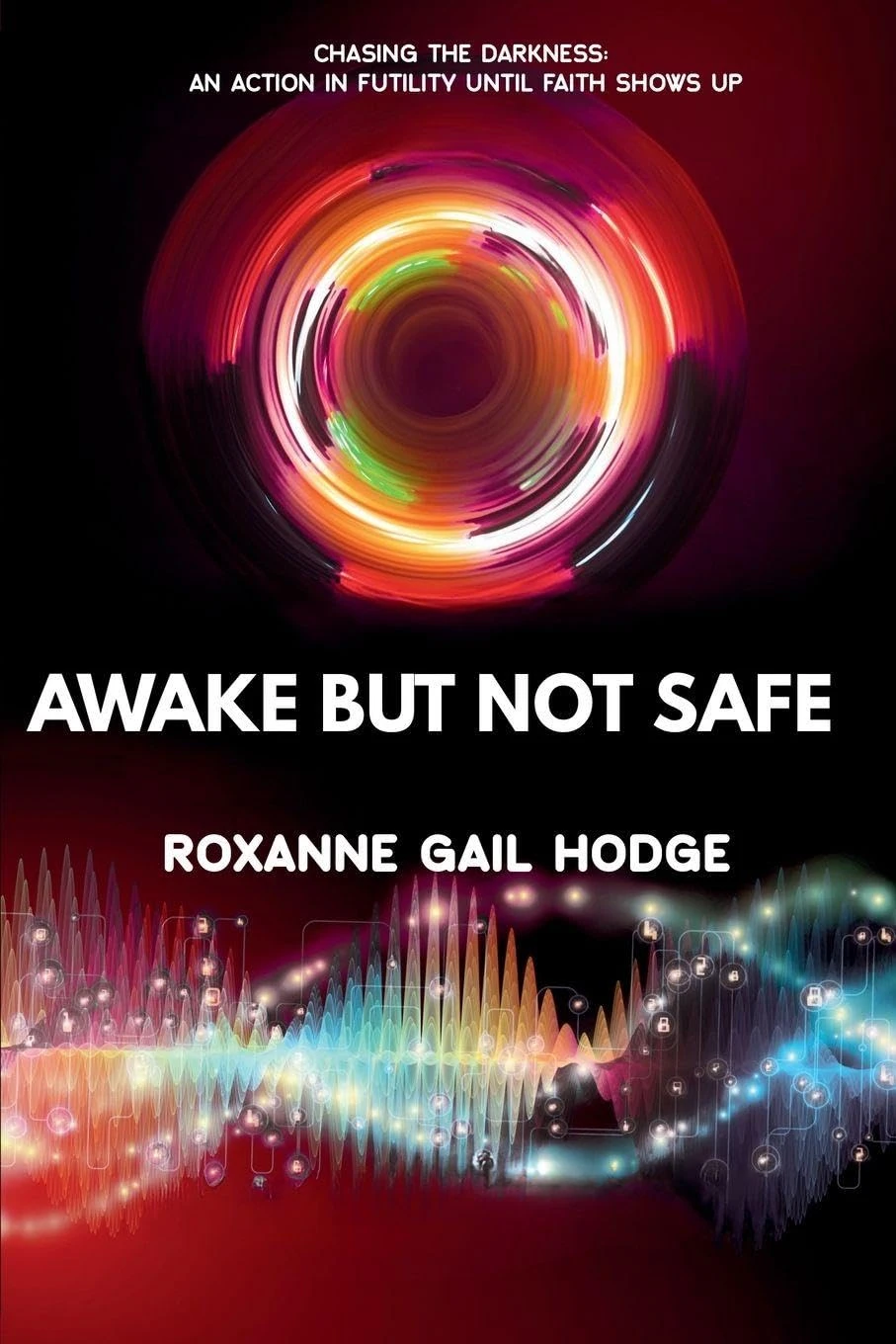
Awake But Not Safe
Ready to Read It?
Use the button or the permanent True Voice Review purchase link.
TrueVoiceReview.com/b/awakebut Scan to Buy the Book
Quick Take
Its strongest suspense grows from the collision between professional secrecy and intimate responsibility.
Short Review
Roxanne Gail Hodge’s Awake But Not Safe combines Christian suspense, family drama, and an expanding conspiracy involving critical infrastructure. Monique Yorkshire’s investigation becomes intensely personal when she discovers that a dangerous target is involved with her sister, Torrie. A violent attack leaves Monique hospitalized and unable to explain the secrets surrounding her apparently ordinary life.
The strongest early tension comes from vulnerability. Monique’s mother, Constance, faces medical uncertainty and the strain of protecting a daughter she no longer fully understands. Meanwhile, brief first-person passages enter Monique’s impaired consciousness, where an angelic figure named Gabriel offers spiritual reassurance. Prayer, Scripture, and conversations about belief make Christianity an explicit foundation of the narrative.
Hodge gives the family relationships meaningful space. Torrie’s professional confidence clashes with her difficulty accepting emotional dependence, while Constance’s connection with chaplain Steve Roberson supplies warmth and a mature romantic thread. Reed’s eventual partnership with Monique adds professional respect and restrained attraction.
Short chapters and direct prose keep the story approachable, though repeated investigative discussions and extended domestic scenes produce uneven pacing. Monique’s rapid return to demanding activity after severe injury, along with convenient security failures and institutional decisions, also strains credibility.
The novel’s most compelling broader concern is the danger of trusting automated procedures without human accountability. Readers who value faith, family loyalty, and emotional resilience over tightly grounded procedural realism are its likeliest audience.
Full Review
In Awake But Not Safe, Roxanne Gail Hodge places a familiar suspense question inside an unusually vulnerable situation: what happens when the person who recognizes a threat becomes physically unable to warn anyone? Monique Yorkshire is investigating a dangerous man whose involvement with her sister makes professional distance impossible. When that investigation leads to a brutal attack and a staged automobile accident, Monique’s struggle to survive becomes inseparable from her family’s struggle to understand the life she has concealed.
The opening establishes an effective double deception. Monique approaches Connor Wray believing she can manipulate his interest to obtain evidence; Connor recognizes more about her intentions than she realizes. Their encounters carry tension because each believes the other is being successfully managed. With Torrie, Monique’s ambitious older sister, already entangled with Connor, the investigation has immediate emotional stakes. The danger reaches into an existing family relationship before its broader implications become apparent.
The hospital setting gives the early narrative its strongest organizing pressure. Monique’s mother, Constance, must navigate incomplete medical explanations, frightening alarms, practical responsibilities, and the uncertainty of waiting. Her impatience and occasional anger make her more convincing than an endlessly composed bedside caregiver. Hodge understands that helplessness often emerges through ordinary frustrations: an unanswered question, an unfamiliar staff member, or another conversation that provides reassurance without clarity. The hospital scenes make vulnerability feel personal before the conspiracy becomes expansive.
Monique’s impaired consciousness introduces a second narrative register. Brief passages in first-person present tense interrupt the surrounding third-person storytelling, translating her confusion into fog, water, darkness, distorted voices, and sudden pain. Gabriel, an explicitly angelic presence, offers reassurance and elusive guidance. These interludes establish the novel’s spiritual framework early. Christian faith is central to how its characters interpret suffering, protection, and responsibility; prayer and scriptural reflection remain visible parts of the story.
The family relationships supply much of the emotional substance. Torrie’s investment in professional competence makes emotional uncertainty particularly difficult for her. Her responses can be abrasive, but her discomfort with vulnerability gives her development a recognizable foundation. Constance’s growing connection with hospital chaplain Steve Roberson adds warmth and a mature romantic thread. Their conversations address loneliness and companionship alongside the immediate emergency, allowing the family’s life to contain possibilities beyond fear.
Although the subtitle identifies this as a Monique and Reed suspense novel, the partnership develops after a substantial opening devoted to Monique’s attack and hospitalization. Readers expecting an immediate romantic pairing should anticipate a gradual introduction. Reed becomes an attentive professional counterpart whose respect for Monique’s intelligence matters more than overt romantic display. Their connection offers understated attraction within a story primarily concerned with investigation, survival, and trust.
As the narrative broadens into coordinated threats involving corporate systems and critical infrastructure, its most interesting idea emerges: danger can hide within procedures that appear to be functioning correctly. Automated approvals, institutional complacency, and divided responsibility become sources of suspense. The novel is especially effective when it asks who remains accountable after everyone has accepted a reassuring report. Its concern with human judgment gives the technological threat a clear thematic purpose.
The execution is uneven, however. Monique’s movement from profound medical incapacity into demanding investigative and tactical activity requires considerable suspension of disbelief, despite recurring reminders of her weakness. Institutional decisions and security failures also frequently serve the needs of the next confrontation more readily than they establish convincing professional practice. Readers seeking rigorous medical, intelligence, or technological realism may find these shortcuts distracting.
The prose is direct and accessible, with short chapters and frequent scene changes encouraging forward movement. Much of the investigation unfolds through dialogue, briefings, and collective interpretation. That structure makes the reasoning easy to follow, but repeated summaries sometimes explain discoveries beyond their dramatic usefulness. Familiar gestures, recurring descriptions of exhaustion, and occasional grammatical or continuity slips further interrupt the flow. Domestic scenes bring welcome tenderness, although their detailed meals, coffee breaks, and conversations sometimes soften urgency at moments when the larger threat demands momentum.
Ultimately, Awake But Not Safe offers its clearest appeal through the combination of family loyalty, spiritual reassurance, and an endangered heroine determined to remain useful. Its strongest suspense grows from the collision between professional secrecy and intimate responsibility. Readers receptive to overt Christian themes, patient relationship development, and a conspiracy plot that favors emotional conviction over procedural precision will find a selectively engaging story with a compassionate center.
Pull Quotes
Content Notes
Language: Occasional mild to moderate profanity, including “damn,” “dammit,” “hell,” and an isolated stronger term; occasional religious exclamations. No notable slurs identified.
Violence: Moderate, with intense sequences involving assault, attempted murder, gunfire, explosions, hostage threats involving children, and fatalities. Blood and serious injuries are described without sustained anatomical gore.
Sexual Content: An extramarital affair is discussed and implied; flirtation, embraces, and kissing. No explicit sexual scenes.
Drugs/Alcohol: Social drinking in bars and at home; one scene of excessive drinking. Medical drugs and deliberate poisoning are depicted; no recreational illicit drug use identified.
Sensitive Topics: Traumatic brain injury, coma, resuscitation, medical vulnerability, psychological distress, bereavement, infidelity, coercion, terrorism, surveillance, and threats to public safety.