
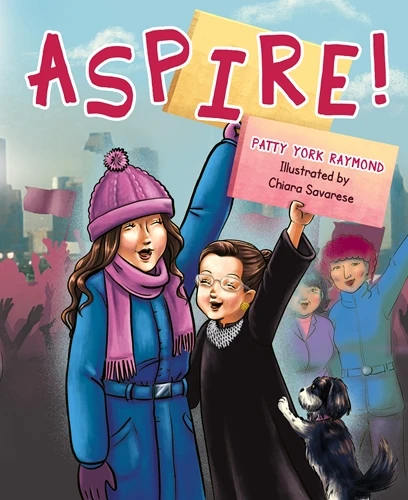
Aspire
Ready to Read It?
Use the button or the permanent True Voice Review purchase link.
TrueVoiceReview.com/b/aspire Scan to Buy the Book
Quick Take
A warm, rhyming celebration of mother–daughter time, Aspire! turns everyday weekends into a vocabulary of confidence—brilliant, brave, empathetic, curious—inviting kids to dream bigger and stand taller.
Short Review
Aspire! is an uplifting, rhythmic picture book about a mother and daughter’s “girls’ weekends” and the many ways a child can grow into confidence. Through chores, schoolwork, self-care fun, movie marathons, and community field trips—from the zoo to the planetarium—the story highlights a wide spectrum of strengths, each capped with a repeating affirmation: “You’re brilliant,” “You’re ambitious,” “You’re empathetic,” “You’re kind-hearted,” and more.
That variety is the book’s standout asset. It doesn’t limit empowerment to achievement or toughness; it elevates generosity, curiosity, creativity, and voice as equally powerful traits. The read-aloud cadence and predictable refrain make it engaging for young listeners, while the busy, expressive illustrations add humor, warmth, and plenty of details for children who love to linger on a page.
The book also carries an explicit message of women’s legacy and equality—an intentional, hopeful perspective that many families, educators, and librarians will welcome. Readers looking for subtlety may find it more direct and message-driven, and the “girls’ weekend” framing is clearly gendered. Still, for audiences who want a confident, encouraging book that gives kids language for their inner strengths, Aspire! is a strong, classroom-friendly pick.
Full Review
Aspire! is a bright, affirming picture book that frames everyday “girls’ weekends” between a mother and daughter as something bigger than a treat: they’re a training ground for character, curiosity, and self-belief. Built in rhythmic, read-aloud-friendly couplets, the story follows a young girl and her mom through chores, school projects, self-care fun, movie marathons, and field trips around town—zoo, science museum, butterfly center, planetarium, even a flight simulator—each experience ending with a simple refrain of praise: “You’re brilliant,” “You’re ambitious,” “You’re empathetic,” and more. The cumulative effect is deliberate and powerful: a child hearing many different kinds of “you can be” until it starts to feel inevitable.
The book’s central strength is how it expands the definition of “strong girl.” Instead of treating strength as a single trait (toughness, boldness, achievement), it presents it as a spectrum: generous, kind-hearted, fierce, inquisitive, pioneering, daring, creative, outspoken, honorable. That range matters. It tells children—especially girls—that their best qualities won’t always look like the same stereotype, and that tenderness and courage belong in the same sentence. The mother’s voice is consistently warm and steady, turning ordinary moments into identity-building statements. For many families, educators, and librarians, that repeated affirmation will be the reason the book gets reread.
The premise is also refreshingly grounded. Rather than hinging on a single fantasy plot, it honors the real-world rituals that shape a child’s confidence: finishing chores, helping at home, learning through hands-on messes, getting out into the community, and celebrating effort. Even the humor stays kid-forward—small exaggerations and playful asides that keep the tone light while reinforcing the message. The story’s episodic structure makes it easy to read in one sitting or in shorter chunks, and the consistent “You’re ___,” refrain gives children a satisfying pattern they can anticipate and participate in.
Visually, the illustrations (colorful, expressive, and scene-rich) do a lot of the storytelling work. The pages are packed with contextual detail—props, environments, facial expressions—that support comprehension for younger listeners and reward older children who like to “read the pictures.” The mother-daughter bond is shown as affectionate and supportive without sliding into perfection; the child can frown, struggle, make a mess, and still be met with encouragement. Several spreads lean into imaginative play (superhero vibes, big emotions during movies, playful bravado), which aligns well with the book’s goal: letting kids practice confidence in safe, everyday ways.
Thematically, Aspire! is an empowerment book with an unmistakable point of view: it celebrates women’s strength across generations and explicitly nods toward equality and social justice. That will be a feature, not a bug, for many readers—especially those looking for picture books that normalize civic values like fairness and voice. It also situates aspiration as both personal and communal: the child’s dreams connect to the women who came before and the daughters who come next. Importantly, it keeps the lens hopeful and age-appropriate, emphasizing pride and possibility rather than fear or anger.
For classroom and library use, the book has clear advantages: a strong read-aloud cadence, repeated language that supports early literacy, and multiple natural discussion prompts (“What does ‘inquisitive’ mean?” “When were you daring?” “How do you show empathy?”). The back matter that introduces careers and definitions extends that usefulness, turning the reading experience into a springboard for vocabulary, role exploration, and “what do you want to be?” conversations.
Some limitations are worth noting for reader-fit. The book is intentionally message-forward; families who prefer subtler moral framing may find the affirmations frequent or the empowerment theme on-the-nose. The “girls’ weekend” framing is part of its charm, but it is also clearly gendered; readers seeking more gender-neutral language may not connect as strongly. And while the rhyme generally supports flow, occasional lines prioritize the beat over natural phrasing, which can make a few passages feel slightly more “performed” than conversational.
Overall, Aspire! succeeds at what it sets out to do: give children a repeated, memorable vocabulary for their best selves—then show them that those qualities are built in kitchens, museums, skating rinks, and ordinary Saturdays with someone who believes in them.
Pull Quotes
Content Notes
• Language: None to mild; affirming, child-friendly wording.
• Violence: None; a few “scary movie” reactions are playful and brief.
• Sexual Content: None.
• Drugs/Alcohol: None.
• Sensitive Topics: Light mentions of equality, social justice, and advocacy/marching; presented positively and age-appropriately.