
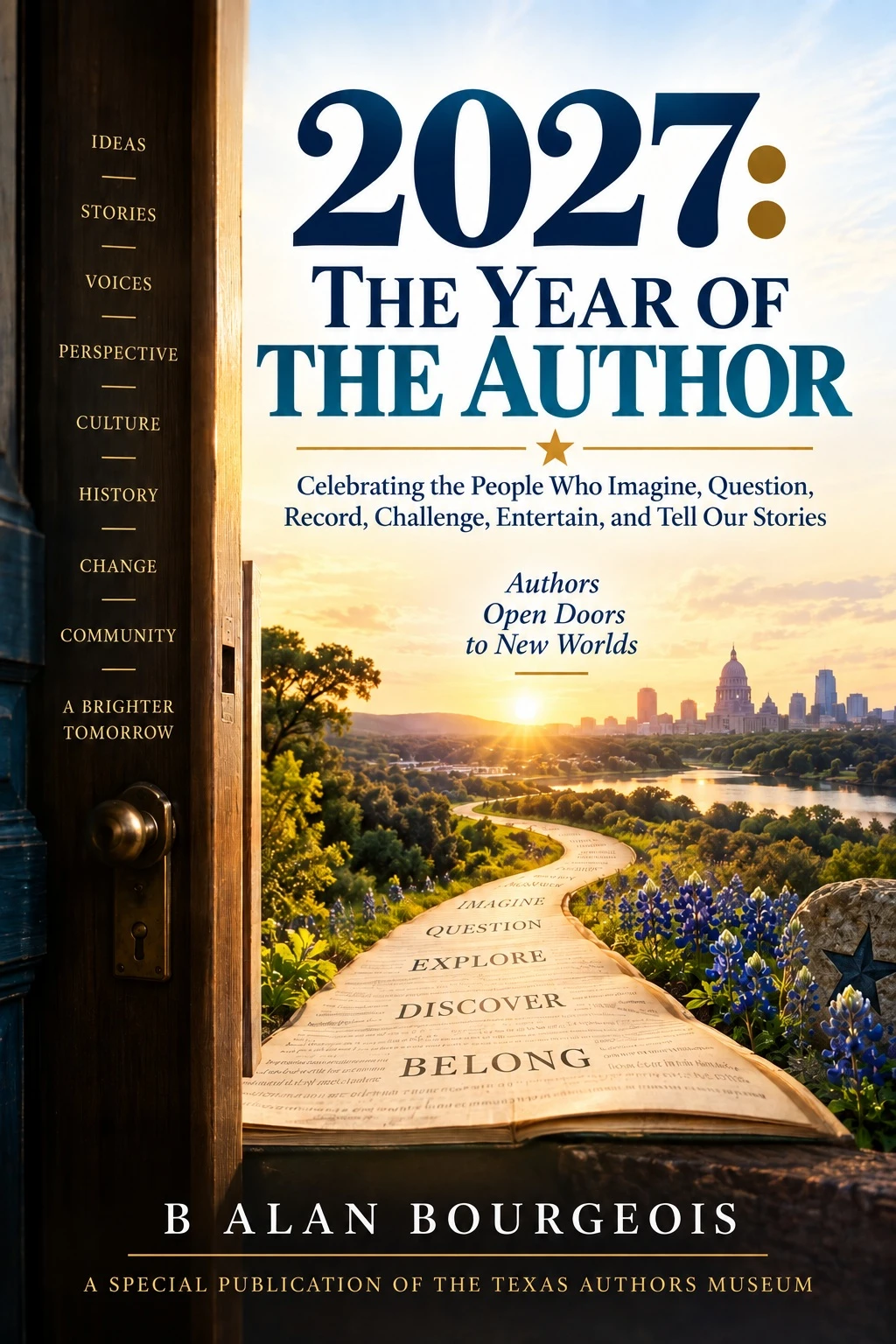
2027: The Year of the Author
Quick Take
A thoughtful, practical celebration of authorship that looks beyond sales and status to recognize the imagination, labor, responsibility, community, and human judgment behind the books readers value.
Short Review
2027: The Year of the Author is an accessible blend of manifesto, professional reflection, and practical workbook built around the idea that literary culture should intentionally recognize the people who create written work.
B Alan Bourgeois defines authorship broadly, embracing writers across genres, formats, career stages, and publishing models while rejecting the idea that legitimacy depends on fame, sales, or who published the book. The strongest sections examine the invisible work behind authorship, the tendency of writers to rush past their own accomplishments, and the growing importance of human judgment and accountability in an era of generative AI. The book argues that technology can assist writers without replacing the intention, experience, responsibility, and creative decision-making at the center of genuine authorship.
Later chapters shift toward action, encouraging authors to strengthen visibility, reconnect with readers, revive backlist titles, collaborate, work with libraries and bookstores, understand rights, and protect the creative habits sustaining their careers.
Because the book is explicitly tied to an advocacy initiative, readers looking for academic literary analysis or heavily researched publishing history may find its short, declarative chapters comparatively simple, and several themes recur throughout. Yet its clarity is part of its usefulness.
Best suited to authors, writing organizations, libraries, bookstores, and literary communities, 2027: The Year of the Author makes a persuasive case that celebrating authors should mean more than praising success. It should mean recognizing the imagination, labor, responsibility, and persistence that allow books to exist at all.
Full Review
2027: The Year of the Author is part manifesto, part professional reflection, and part practical workbook built around a simple proposition: literary culture spends considerable energy celebrating books, publishing success, and reading, but not always enough time recognizing the human beings who make written work possible.
Created in support of the Texas Authors Museum’s Year of the Author initiative, the book proposes an alternating tradition in which even-numbered years recognize readers and odd-numbered years recognize authors. Its ambition extends beyond Texas, inviting libraries, schools, bookstores, publishers, museums, literary organizations, readers, and writers to adapt the concept within their own communities.
B Alan Bourgeois approaches authorship expansively. Novelists, historians, poets, memoirists, journalists, screenwriters, academics, cookbook writers, technical writers, educators, and people recording family or community histories all belong within the book’s definition of the author. Just as importantly, it refuses to treat publishing method as a hierarchy of legitimacy. Traditional, independent, hybrid, academic, nonprofit, digital-first, small-press, and other paths are presented as different professional models rather than measures of personal worth.
That inclusiveness gives the book much of its appeal. Authors who have felt overlooked because their careers do not resemble conventional publishing success stories are likely to find reassurance here without the book descending into empty affirmation. Bourgeois repeatedly acknowledges that quality standards, professional conduct, criticism, editing, contracts, economics, and accountability still matter. His argument is not that every book deserves praise. It is that completing and responsibly placing written work into the world deserves recognition independent of fame.
The book is organized into five broad movements: defining who authors are, examining what they contribute, encouraging authors to recognize their accomplishments, offering practical ways to use the Year of the Author, and finally expanding the initiative into a continuing cultural tradition. Short chapters and frequent prompts such as “Celebrate the Author” and “Make It Yours” make the material easy to move through and give it a workbook quality. The structure is particularly well suited to author groups, workshops, library programs, professional organizations, or readers who prefer brief sections that can be considered individually rather than a continuous extended argument.
Some of the strongest passages explore the invisible labor behind authorship. Bourgeois points beyond launches and book covers to research, revision, permissions, metadata, correspondence, contracts, interviews, events, deadlines, production problems, and the countless choices hidden behind a single byline. The observation that authors frequently move immediately from one milestone to the next—finishing, editing, publishing, marketing, selling—helps explain why creative accomplishment can become strangely invisible even to the creator.
The discussion of human authorship in the age of generative AI is similarly measured. Rather than treating technology as either salvation or enemy, the book argues that the meaningful question is whether the human author remains the creative and intellectual center of the work. Intention, lived experience, judgment, responsibility, cultural context, revision, ethical choice, and accountability become the qualities by which human authorship is distinguished. That balanced framing should appeal to writers wary of both technological panic and uncritical enthusiasm.
The second half becomes increasingly practical. Authors are encouraged to revisit their biographies and websites, reconnect with readers, reassess backlist titles, build relationships with libraries and bookstores, collaborate with other writers, understand contracts and rights, preserve files, and protect the writing time that makes a career possible. Particularly useful is the reminder that visibility is not synonymous with vanity: readers, librarians, reporters, and organizers cannot discover authors who provide no clear way to find their work.
The book’s chief limitation grows directly from its purpose. This is an advocacy publication, and readers seeking a deeply researched history of authorship, literary criticism, publishing economics, or sustained argument supported by outside scholarship will find something different here. Ideas are generally presented in compact, declarative form, and several themes—recognition, visibility, community, legitimacy, and the author-reader relationship—recur throughout. For readers already immersed in author advocacy, some passages may feel familiar.
That repetition, however, also makes sense when the book is viewed as a programmatic guide rather than a conventional nonfiction monograph. It is designed to generate conversations, events, reflection, and participation. Its closing sections explicitly shift responsibility outward, asking libraries, bookstores, schools, museums, publishers, readers, and authors to create their own local versions of the celebration.
2027: The Year of the Author ultimately succeeds because it understands celebration as more than applause. Its version of honoring authors includes protecting rights, strengthening professional standards, preserving literary history, supporting fellow writers, maintaining relationships with readers, and continuing to create. It is an accessible, purposeful call to recognize not simply books as cultural objects, but the human imagination, labor, judgment, and persistence behind them.
Pull Quotes
Content Notes
Language: Clean; no notable profanity or slurs.
Violence: None.
Sexual Content: None.
Drugs/Alcohol: None of significance.
Sensitive Topics: Brief references to illness, criticism, professional rejection, cultural disagreement, bias, misinformation, and the pressures and uncertainties of creative careers; none are presented graphically.